
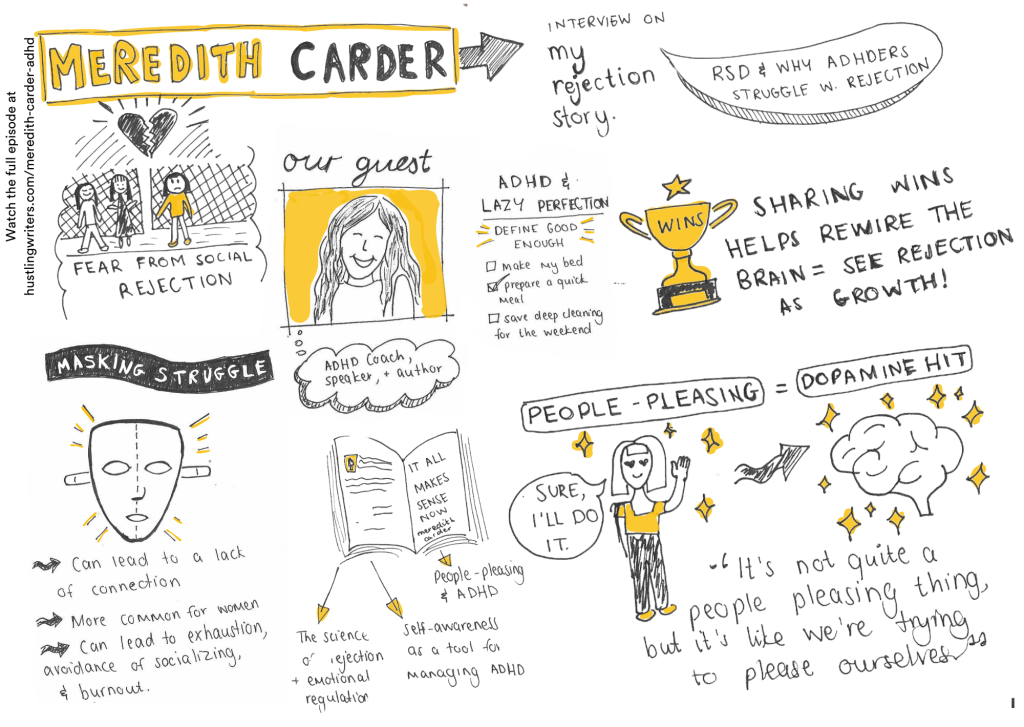
Meredith Carder is a trailblazing ADHD coach, author, and advocate who knows firsthand the challenges of navigating life with ADHD. From the weight of rejection to the struggle of masking, Meredith has been there—and now she’s helping others rewrite their stories. As the author of It All Makes Sense Now: Embrace Your ADHD Brain to Live a Creative and Colorful Life, she’s a powerful voice for adults learning to thrive with neurodivergence.
In this episode, Meredith takes us inside the ADHD brain, breaking down the emotional toll of Rejection-Sensitive Dysphoria (RSD), the burnout of perfectionism, and the dopamine-fueled trap of people-pleasing. She shares her personal experiences and actionable strategies for managing emotional dysregulation, finding authenticity, and staying motivated for the long haul.
For anyone listening, you can order a copy of “It All Makes Sense Now” by clicking here!
Follow Meredith Carder on Instagram @hummingbird_adhd.
Subscribe to Meredith’s newly-launched Substack: https://meredithcarder.substack.com
To find out more about Meredith Carder including her book, coaching, and ADHD community, visit: https://www.meredithcarder.com
Without you, this show wouldn’t be here. If you want to help us reach even MORE people, than please subscribe and review. Thank you so much!
Note: This is a rough transcript
Alice Draper (00:00.829)
Meredith, welcome to my rejection story. Before we get into the interview, do you mind introducing yourself and a little bit about what you do?
Meredith Carder (00:08.64)
Yes, well thank you so much for having me. My name is Meredith Carter. I’m an ADHD coach, creator, and writer. I live in the Phoenix, Arizona area. I’m a mom of three and recently wrote my first book on adult ADHD.
Alice Draper (00:30.223)
I loved the book, so I’ll just preface with that. Yeah, it was such a great book and I felt so affirmed as someone who also has ADHD. I’d love it if you could share a little bit about your work in ADHD and why you decided to write the book. It all makes sense now. Did rejection by any chance play a role in your decision to write this book?
Meredith Carder (00:56.618)
Yeah, mean, rejection has like played a role in a lot of things in my life. To answer your question about my work with ADHD, I began working with adults with ADHD several years ago now. I had been diagnosed with ADHD after my daughter was diagnosed and I couldn’t believe how much more of my life started making sense, hence the title of my book.
And it just really inspired me to connect with other people out there that were processing an adult diagnosis. I was working in employee development and training at the time and doing a lot of coaching for my work. So getting into the ADHD coaching field made a lot of sense for the skills that I had.
you know, throughout that journey, started talking about ADHD publicly online, mostly on Instagram. And, that really allowed me to reach a big audience of people and really realize even more how many of us there are out there that are working to make sense of this diagnosis, to contextualize a lot of things that happened in our past and really have the pieces start to fit together.
Alice Draper (02:22.037)
Yeah, yeah. Having the words for it, like as you were just saying, it changes things drastically, drastically. So I’m not surprised that you’ve attracted such a big community, being someone who can articulate and put words to things that we actually didn’t have words for for most of our lives. And I think many of us were undiagnosed for most of our lives.
Meredith Carder (02:41.794)
Mm-hmm.
Alice Draper (02:45.749)
I’m curious about your childhood and growing up. I know we both grew up with undiagnosed ADHD. Did you experience rejection growing up from teachers, peers, or even yourself because of your symptoms? And how did these experiences shape the way that you viewed yourself as an adult? And maybe even as a child and adolescent?
Meredith Carder (03:09.004)
Yeah, I did definitely experience quite a bit of rejection, both from teachers and from peers. I did do pretty well in school. I really like to learn. I think that’s common with a lot of people with ADHD is our brains are so driven by interest. So if what we’re learning about is interesting to us, we’ll be engaged, right?
But the problem is we don’t always get to choose what we’re learning, especially in primary school. So I was that child that was constantly redirected because I was doodling or daydreaming. I also really heard from teachers quite often that I talked way too much. And I just never was really reaching my potential according to a lot of my teachers.
I heard a lot of like, she’s so bright, but she could do so much more if she could just focus. And I think those statements are meant to be encouraging, but they really are a little bit rejecting, right? Like they’re pointing out that we’re just not hitting the mark. To answer your question about peers, it really, something that really jumps out in my memory that I still think about quite often today, especially as I’m raising children.
is when I was in fifth grade, I went to a very small school and we just had one classroom for each grade level. So I went to school with the same 25-ish kids from kindergarten to sixth grade. And I had two very close friends that I’d been best friends with for a very long time. And in fifth grade, I remember what felt like out of the blue, they came to me and told me that they wanted to stop being friends with me because
They didn’t think I was going to be popular when we transitioned to junior high in a couple years. And that was devastating to hear as a fifth grader. And because we were such a small school, I didn’t really have anybody to fall back on. I didn’t have a group of people to kind of pick me up and show me my value. So that really stuck with me. And I think it informed a lot of my relationships going forward. I think I feared rejection in relationships.
Meredith Carder (05:28.942)
after that incident for quite a while.
Alice Draper (05:32.747)
Yeah, yeah, mean, just, like, my heart is sore for this little fifth grader just listening to that story. It’s just the worst thing that can happen, I think, when you’re in school is being ousted from a group like that. Yeah, it’s interesting how these shapes these experiences that we don’t really put too much thought in. And I think in my own life, like,
Meredith Carder (05:46.978)
Yeah.
Alice Draper (06:01.623)
how much I didn’t do anything that would ever put me in the wake of rejection and like the good chunk of my early adulthood. And I wonder, you know, I remember being rejected by someone who I asked to dance with me at like a school social, it was a friend of mine, so I thought that he would dance with me because we were friends and he just laughed at me. And I think from that point onwards, I never like…
would ever tell anyone that I liked them or had feelings or anything. I wonder, you know, was it just rejection-sensitive dysphoria or was I marked by that memory and did that play out? So yeah, anyway, I really feel for a little fifth grade Meredith.
Meredith Carder (06:45.834)
Yeah, it definitely informed. I think it was the first time I really received that message that I wasn’t really fitting in in the way I thought I was. And it also, I think, drove a lot of behavior like that desperation to fit in and doing everything I could to mask these symptoms I didn’t know were ADHD.
Alice Draper (07:07.031)
How common is masking for ADHD is? In your work as a coach, how often do you see masking show up for clients you’ve worked with or people in the community?
Meredith Carder (07:20.148)
I think masking is almost a universal experience for people with ADHD, at least at some level, right? Some people will mask more than others. A lot of the research shows that masking behaviors are more prevalent with girls and women than they are with males. And I think a lot of that has to do with how we’re socialized. I think that there’s different expectations.
for little girls than there are for boys. So we may be hyper, we may talk too much, we may have some of those more outwardly noticeable behaviors that come with ADHD, but with boys, there’s more of that, boys will be boys. This is a normal boy behavior type mentality and girls are told that that’s not okay. So we figure out really early on.
that if we want to avoid criticism, if we want to avoid rejection, if we want to fit in, we have to find ways to mask those behaviors. So, you know, again, it’s not just women. think everyone, every human, probably, whether they have ADHD or a neurodivergent condition or not, probably masks certain natural tendencies. But I think it is so much more common for people with ADHD because our tendencies are so
different than the norm. So we want to kind of inadvertently do what we can to just survive and feel comfortable and not have to face the pain that comes with being different.
Alice Draper (08:56.279)
Yeah, yeah, yeah. Something that I, someone once told me and I’m interested if you have any thoughts on it, but it’s something I never thought about before. And she said that women are more likely to fear rejection. And it could also translate to masking. Women may be more likely to mask because historically they’re, I don’t know if it goes down to girlhood, but historically women were dependent on men to be their caregivers, to like, you know, be the…
ones that would go out hunting, if you’re back to like ancient sort of hunt together days, all the ones that were breadwinners until like two generations ago. So that need to mask was much more innate and a woman, a girl, whereas boys could sort of be themselves, maybe be rowdy or so. The behavior around ADHD is…
kind of often accepted in young boys. Like, he’s causing a fight because he’s a boy. He’s like not sitting still in class and fidgeting because he’s a boy. And it’s just not really accepted, I guess, because of the norms of girls. But I thought it was really interesting that perspective of girls and women have needed to depend on, historically, men for their shelter and security and safety.
Meredith Carder (10:10.262)
Yeah, that is really interesting to think about. I definitely do think there are evolutionary components to why some of these wave behaviors exist.
Alice Draper (10:19.767)
It makes me think, because I think that my father, my grandmother have ADHD and my grandmother was so well masked, you would never think that. But when I started introspecting on like family lineage, I was like, my gosh, she just trained herself to never show up in the way that you would. But I could see that, you know, all the subtle ways in which she may have ADHD. But anyway, going back to the topic of masking, what are the dangers of masking?
Meredith Carder (10:50.712)
think there’s a lot that can be really tough with masking because oftentimes when we’re masking, we’re not just kind of subtly not showing behaviors, we’re like over-correcting for them.
So we may struggle with issues at work. Like perhaps we’re struggling to really meet deadlines and expectations. So instead of asking for accommodations, we push ourselves super hard and we over correct. So we overproduce, we over deliver. And you know, that can work out great for us at the beginning. And then typically we end up burning out because we’re awkward.
way beyond a capacity that makes sense for our brain. So there’s that risk that it’s just the exhaustion and the burnout that can come from doing way too much to overcorrect for symptoms. I also feel like there’s a feeling of inauthenticity that can happen. I feel like a lack of connection that can occur when we are
in social groups and work and things like that. I often talk to people that say that they’re like a different person for every single situation they’re in. They’re almost like a chameleon. And that’s not terrible. It’s great that we’re adaptable. And I do think that we have often very multifaceted personalities. So that’s part of it. But when we’re having to completely change ourselves to fit in, that’s hard work.
Over time, we get tired, so we might avoid connection. We might avoid being in those situations that we have to mask. And it just can be really tough to not feel like you’re accepted for how you are. If you’re always having to hide something, we kind of start to live in fear of being figured out. And that’s just not a great way to go about the world.
Alice Draper (12:56.779)
Yeah, yeah, totally agree. In your book you wrote, you gave an example of spending a full day masking and if you are super fatigued or super exhausted at the end of the day, this might be a sign that you’re masking, generally related to. So for someone who feels like this is their identity, they’re mostly masking at work or with friends or in any other setting, how would…
one go about trying to undo that and trying to be a little bit more of their authentic self.
Meredith Carder (13:27.736)
You know, one thing I talk about in my book, strategy that I think we can start with is to ditch the low reward.
masking first because we’re not gonna like overnight just be able to show up authentically. We probably do need to mask some things, you know, to be able to fit in. Like we can’t blurt out every thought that comes into our head because we might hurt people’s feelings a lot or it’s just not gonna help us in our careers and things like that. So thinking about the situations in your day and where you might be masking and where it probably doesn’t, you probably don’t really need to be. So one of those might be
If you like say you work in person and you have a high need for physical movement, like you’re a fidgeter, oftentimes we get really hyper aware of our fidgeting and we’ll just like try to sit up straight and we’re like spending a whole meeting focused on not fidgeting versus actually just letting our body do what it needs to do and being able to tune into the meeting. So thinking about like instead of
trying to control that behavior, is there a way to express that that’s gonna not be distracting to everyone else, but also help your need for movement? Can you doodle? Can you bring a fidget with you and try to just be accepting of those behaviors? Can you ask to stand in the back of the meeting or something like that? That would be like an example of usually like a low reward because you not moving is really not that big of a deal to most people, most likely.
So thinking about a way where you can kind of unmask that behavior I think is really helpful. And then once you start kind of finding those low reward masking behaviors, the less of those you have to put bandwidth towards, the more energy you’re gonna have for everything else. So that’s something I think is a great start for that. I also think that thinking about cultivating,
Meredith Carder (15:26.296)
groups of people and community that you can be with that you’re not required to mask. So who are those friends that you might already have that you can just kind of talk naturally, that you’re not, like you can talk in tangents and interrupt each other and nobody’s apologizing the whole time. Like who are those people? And if you don’t have them, see if you can start seeking out people that…
have a similar profile than you do. Like find ADHD community, find a group or people that are open about that where you feel like you can be yourself because that’s just kind of a relief to the masking we have, we are kind of required to do by society the rest of the time.
Alice Draper (16:08.075)
I love that so much. So finding accommodations, which is, I think you gave some examples on your book of like, I don’t know if this is related to finding accommodations, but sort of going for a walk and listening, you can absorb more information, which I totally related to versus just sitting at a screen and listening that way. And finding a community. I have a strange question for you. Do you think people with ADHD are more drawn towards other people with ADHD? Cause many of my best friends.
also have ADHD and the way we talk is like manic and insane. And I think a lot of people would be, they had to listen to us, like, how did you guys get to like 70 different points and not finish a single like discussion that you opened? So yeah, do you advise that we make friends with other people?
Meredith Carder (16:54.126)
Yeah. I mean, I don’t have any scientific research to back it up, but I do think that in my personal experience, it was really actually super fascinating to get diagnosed with ADHD and start talking to friends about it because, you know, a lot of them were like, I was diagnosed with ADHD in college and they’d never told me that. Or they were like, I’ve been wondering if I have ADHD.
And over the last several years, a lot of them have been diagnosed and they were people I already had connected with and they were usually the people that I felt the most comfortable with, that I were my kind of inner circle already. So I do think there’s something to that. There’s a comfort in not feeling different, to feeling like people can relate to what you’re going through. So if you’re open enough with people and they’ve been able to see that window,
and share that they’re kind of on the same page, think there is something going on there where we are kind of finding those people that truly get how our brain is wired.
Alice Draper (18:01.707)
Yeah, I think it makes sense. think, you know, if the way you talk and the way you engage with the world attracts certain people, maybe they think a little bit similar to us. Moving on to the topic of rejection. Are people with ADHD more sensitive to rejection than, I guess, neurotypical people?
Meredith Carder (18:10.306)
Mm-hmm.
Meredith Carder (18:23.67)
Yeah, it is thought that Many people with ADHD struggle with something called RSD, rejection-sensitive dysphoria. And so basically, that is the reaction that happens when we’re faced with a real or perceived rejection. It’s an emotional response. It’s like a form of emotional dysregulation where we react really, really
I don’t want to use the word dramatically. We really feel it. Like it’s a big reaction. And a lot of the theories around this are because of all those early messages we receive as people with ADHD that our behaviors are wrong, we’re doing something wrong. So we get like a heightened awareness and we begin to kind of respond every time in the same way, even if the threat isn’t
you know, quite as substantial. So it’s a very painful thing, I think, for people to experience, but I think it’s extremely common among people with ADHD that whenever I talk about this with people, they’re like, my gosh, being able to like understand that this is a thing for me is like almost freeing because oftentimes we…
We know we’re maybe sensitive, but we don’t really realize to the extent and the amount is impacting our decisions in our life because it’s not just that reaction that’s so hard. It’s the fact that we start to want to avoid that reaction. So we may, you know, change our behaviors to avoid experiencing that feeling of RSD. And that can look like anything from not pursuing opportunities, from not putting ourselves out there.
from not wanting to connect socially and things like that.
Alice Draper (20:15.371)
which is a huge part of the podcast’s mission is, you know, helping people overcome that fear of rejection and not putting, pursuing opportunities. But before I get into that, could you, and you sort of wrote about this in your book, and so I’m curious to just get onto the podcast. Could you explain a little bit in terms of what happens in our brain when we’re rejected or we perceive a rejection as someone with an ADHD brain? What sort of…
happening up there that makes us feel the way we feel.
Meredith Carder (20:48.3)
Yeah, so usually what’s happening is we’re like, when we go into that rejection, usually we’re kind of in like our zone of regulation, right? We’re regulated, we’re fine. And then when we perceive that rejection, we become really dysregulated. that can look like, it can look different for everyone, but it can look like anger, it can look like physical feelings of like,
Your face getting flushed. It can look like headaches. It can look like Just kind of that physical reaction to stress. It can look like Freezing so for some people instead of getting angry they get frozen for some people they cry It’s just it’s gonna be a little bit different for everyone, but it is a response of being having a dysregulated nervous system and it can happen really like
regardless of the size of the reduction or the intent too.
Alice Draper (21:50.039)
Do you know why we struggle or people with ADHD struggle with regulating emotions? it purely messages from childhood or do know if there is something else?
Meredith Carder (22:03.67)
Yeah, emotional regulation is not currently part of the diagnostic criteria for ADHD, but it actually was for a really long time. And a lot of researchers are trying to get it back into the diagnostic criteria, but they do think it is part of our nervous system wiring to have a smaller zone of regulation. So again, that’s that space where you’re feeling good, you feel like you can handle stressors, you can…
Alice Draper (22:12.087)
Okay.
Meredith Carder (22:31.15)
kind of just roll with things as they come. But people with ADHD tend to move out of that range. Either they get upregulated out, which is more of like the anger and the, you know, feeling like that kind of like intense stress, or they can also go below that, which is feeling kind of apathetic and kind of frozen in that space. So the thought around that is that our ability to stay within that zone of regulation is just smaller with how our nervous systems are wired with ADHD.
Alice Draper (23:01.879)
Mm-hmm, this makes sense. There’s a term that you wrote about in your book, which I loved, called cognitive inflexibility. And you explain this as something that clouds our thinking and blacks out all other perspectives other than the negative intent that we’ve assigned to the rejection or the perceived rejection. Could you explain a little bit more what cognitive inflexibility is and why it’s dangerous?
Meredith Carder (23:27.982)
So people with ADHD struggle with executive functioning. A lot of people have heard that term, but they think it means like we’re just not organized or we struggle with time and things like that, and it does mean that. But your executive functions are a set of self-monitoring type behaviors that happen in your prefrontal cortex. And there’s differences in the ADHD brain with how our prefrontal cortexes function. So.
This is something that’s been really like fleshed out in science that this is really truly something we struggle with. cognitive inflexibility is one of those executive functions. cognitive inflexibility is that ability to like move from, you know, one thought to another and also just kind of like see nuance and things like that. So.
All or nothing thinking kind of falls under that umbrella. That’s probably the layman’s way to think of it as oftentimes it’s harder for us to examine all sides and kind of look at something in a flexible way. So if we’re feeling rejected, we’re already going to be emotionally dysregulated. So we’re not, you know, thinking at our highest level at that point. And then we’re also predisposed to kind of get into that all or nothing thinking. So instead of like,
being like, okay, well maybe this is like, they meant this, or this is the other side of this. We’re usually going to kind of naturally, if we are aware of these behaviors and don’t have tools to work with it, we’re gonna want to kind of assume the worst and kind of dive into that kind of negative thought loop there.
Alice Draper (25:10.903)
Yeah, I’ve been there. Why is self awareness important for managing a rejection senses of dysphoria? And yeah, I guess on that, how can we harness more self awareness?
Meredith Carder (25:24.546)
I think self-awareness is so important with so many facets of ADHD, but specifically with RSD, if we can’t notice the reaction and name it for what it is, then we really struggle to be able to manage that reaction and be able to use tools to regulate ourselves. And what can happen is if we’re feeling all these rejections, all we know is that it feels awful.
and that we don’t wanna feel that again, and we don’t have tools to process it and get ourselves back into a good place, then we’re gonna start avoiding things. We’re gonna start not wanting to have those experiences. And if we’re not aware that that’s a problem and that that’s something that is part of how we’re wired, then we just start to believe, okay, no, anything that’s gonna be…
putting me vulnerable to rejection is bad. I gotta stay away from that. So self-awareness really needs to come into play there so that you might not avoid feeling rejected. Like those horrible feelings are not gonna always be something that we can get rid of in our lives. But if we can name it and start to find ways to externalize the emotion and process it, then…
we’re not going to be as impaired by the after effects of having those types of reactions.
Alice Draper (26:49.803)
Yeah, yeah, You know, as you were talking and also also like reading your book, I was thinking of like that reactive state, you know, getting into that reactive state when someone has rejected you or you perceive a rejection because I mean, like 90 % of the time it’s a perceived rejection. not even a real rejection in my case. That self-awareness piece is so key and it’s so hard, like for me, where I would notice that I…
can reflect on something after it happened and be like, okay, I got triggered, I got emotional, I didn’t react in the best way. But the hardest piece is being able to catch yourself before you react and regulate and then respond. And so you talk about these strategies in your book, but I’m curious if you have any insights on kind of how we can work on catching ourselves before the emotional brain takes over.
and it’s too late and now it’s like an hour later and you’re like, why did I do that?
Meredith Carder (27:50.424)
Yeah, mean, it sometimes can be easier said than done to be able to, I don’t know, I guess what I wanna say is it’s like, you can make progress, but you’re still gonna have those moments where, you know, you’re going to go into that reaction. Like it can really overpower us. think that understanding what your triggers are that kind of cause those reactions can be really important so you can do some mental prep.
and talk to yourself through that as you are experiencing that. Like that’s more useful when you know that there might be some rejection coming, right? Like that’s helpful when we’re thinking about the writing world, right? To know like, okay, I will be getting some negative reviews. And kind of doing that coping ahead of talking to yourself through what these reviews could mean, reminding yourself that it’s not about you.
I actually, something I did for this specific example is I was really scared of what those types of reviews and what they would feel like for me. Because as we know, we can’t publish a book and not experience some rejection somewhere. And I actually read like two and three start reviews of books that I loved. Like books that I thought were absolutely excellent. And it reminded me that even things that I thought were absolutely wonderful, other people didn’t like.
And it wasn’t about like trying to feel better that someone else was getting a bad review. It was more about reminding myself that it’s okay for someone to feel that way about my book and that doesn’t mean that it’s a bad book. And that was kind of helpful to kind of talk myself down with that. And then there’s also just like everyday things you can do to increase that ability to tolerate.
those negative feelings. So a lot of things that help us kind of just have that bigger space for regulation are things that are like exercising as much as you can. Not every well, not as much as you can. Exercising regularly. There could be too much of a good thing, right? But regular exercise, some like community, not being isolated, all of those things.
Alice Draper (29:54.583)
Thank
Meredith Carder (30:05.388)
strengthen our ability to tolerate stressors. So there’s those lifestyle factors as well. I also think that knowing when you’re not in the greatest place to receive rejection can be really helpful. Like if you’re exhausted, if you have gone through some major stressors, that’s a good time to protect yourself from kind of unwanted feedback and things like that. It’s okay to take those times to like recover.
and face those rejections when you are in a more regulated place.
Alice Draper (30:38.199)
On that topic, do you recommend it’s a good idea to almost put guardrails up when you’re in that sort of space where you would say to a one or a boss or someone, maybe don’t give me a rejection or give it to me in this format? Yeah, what sort of ways could we go about it?
Meredith Carder (30:53.782)
Yeah, I love the term guardrails. do, I talk about this a little bit in my book as well, that we can help people understand how to best communicate with us. So that can look like talking to your boss and being like, this is how I best process feedback. I prefer it in written format or I prefer to know if it’s coming, you know, that type of thing.
And really thinking about how you can process those things a little bit better and communicating that to others is really, really helpful. Yeah, and I also think just having those boundaries with the people that you’re around. If you are in a fragile emotional state, you know, it’s okay to ask people to be a little gentler with you for a while or to not just seek out that possible reaction. I know bringing it back to kind of the book world.
We don’t have to read our reviews every day. We don’t even have to read them at all. But we can ask ourselves to not hurt our own feelings if we’re having a really tough day and we’re not feeling very strong to like, that’s not probably the best day to go into your Goodreads and see what people have been saying. So, know, honoring that tendency in ourselves and then also communicating with others about how we receive feedback best is really helpful.
Alice Draper (32:14.291)
Mm, mm, mm. Yeah, this is interesting. I’m just quickly thinking of those follow-up questions and now it slipped out of my head.
Yeah, guess kind of like what I wanted to ask. So now if we could imagine that, you know, we’ve got these guardrails and we’ve communicated like I love the idea of telling us this all in your book, telling your boss that you, you know, it would be great if they could be tech emailed. So then you can like deal with your emotions in private and not in front of him. But there are, I think times where maybe we will still have to.
face difficult feedback in life? mean, I think it’s inevitable for everyone and there’ll be times where it will be face to face. I don’t think there’s a way we can avoid that entirely out of our human experience. I think especially in relationships, there’ll often be times where partners have to tell each other things that are not always nice to hear. Do you have any strategies on kind of how you could sort of, I guess,
be mindful and try take it in a more regulated way than we might want to automatically and actually process the feedback and look at it from an as look at it as objectively as we possibly can.
Meredith Carder (33:39.692)
Yeah, I think that, like you said, we’re not going to always have as much control over these things as we wish we could. And feedback is valuable sometimes. So we do have to get that feedback in real time, and we can’t always direct how we face it. So I do think that in the moment, we can, if we’re noticing it’s one of those reactions where we’re just getting to that level of dysregulation.
We can ask for a break in the conversation for a few minutes to go regulate, do some breathing, calm down. We can really ask questions and try to shift into curiosity. I think a lot of times, so many of us are immediately defensive when we are faced with feedback and…
Oftentimes that approach is, I think it’s really natural, so I don’t want to make anyone feel bad that they get defensive. I think that’s how we’re wired, right? To try to keep ourselves feeling safe. But if we can shift into curiosity, oftentimes that leaves us in a better place at the end of the conversation. Because if we are defending, we’re just creating our position, right? If we’re asking curious questions.
we’re really getting to the root of what that feedback is saying. And it leaves less room for our brains to ruminate and make up a different story about it, right? So sometimes the feedback is more benign than our brain wants us to think it is. And we will get defensive and then we have all these stories going on about what’s actually being said. If we ask curious questions, we get a better overview and we might feel more comfortable at the end of that conversation.
Alice Draper (35:31.797)
Yeah, I love that you touched on that because, you know, going back to the kind of like rigid thinking, once we have that negative thought process and we just run with that, it all kind of, the ruminating all goes haywire from there. And something you touched on in your book was, you know, looking for clarity when there’s any ambiguity. And so that curious part, getting curious means that we can get the clarity. And I think…
A lot of the time it’s not as bad as we’ve sort of jumped the conclusion we’ve jumped to. So getting curious allows us to kind of get the facts all laid out. So that’s just really great. Going back to something that you touched on earlier, you spoke about how many people in your community and many people with ADHD end up, reactions RSD to rejection is to just not pursue opportunities. Also just avoid.
anything that might put you in the face of rejection. Why is this not an ideal way of dealing with rejection and what could we do to, I guess, approach things a little bit differently?
Meredith Carder (36:43.074)
Yeah, I think that, you know, avoidance is something we can do to keep ourselves comfortable in the moment, but oftentimes it’s gonna hold us back from really achieving the things that we desire. And it can keep us feeling isolated and really kind of powerless in our own lives, right? So I do think that we have to be able to
like I mentioned before, a name that that’s happening, right? We don’t always know that we’re avoiding rejection when we are not taking an opportunity. so I think that we have to remind ourselves that, we can handle these things, that we can live through these rejections, and really look at like the, the net positive of doing, you know, facing the possibility of that rejection. So yes, there’s nothing’s up.
going to be 100 % perfect, right? So yeah, we might feel uncomfortable. It might feel really hard. It might be embarrassing to experience that rejection. But when we take those risks, we also might have this really great positive from doing that. We might be able to move forward with our career. We might be able to improve what we do. And we might be able to connect with people we might not have connected with.
If we don’t take that risk, we continue to avoid, oftentimes the only net positive we have is that we didn’t, you know, we didn’t feel bad for a few moments. you know, oftentimes the big picture is that facing some uncomfortable things and building our ability to feel those can really get us closer to the life that we’re looking for.
Alice Draper (38:39.969)
Yeah, I love that. I have a quote on my cork board that says, when you refuse to accept an uncomfortable truth, you choose to accept an uncomfortable future, which I think of in a similar way of avoiding short-term discomfort is allowing for long-term discomfort. I’m curious to know if you have any case studies of people in your community who really struggled with RSD and were able to…
change their relationship and I guess put themselves and I guess take more risks and put themselves in the face of more opportunities by changing this relationship.
Meredith Carder (39:20.246)
Yeah, you know, I have encountered that with many clients. I think for many of them, the key was having a community of people that you could talk about those fears with and normalize those fears. I have people in my group that have started small businesses that were extremely nervous to post on social media about what they were doing.
that really like spent months before they could get started to tell the world about the thing that they were doing. And with support, we’re able to overcome that. And what’s been great is to see that oftentimes they get a lot of positive feedback. They don’t even get the rejection they’re expecting. I had one example of a client that…
wanted, you know, was starting a new career and was so scared to talk about it on LinkedIn because she was worried about judgment and as a lot of people with ADHD have experienced, we change careers a lot. We start new businesses a lot. Like, it’s kind of a common behavior for us. So a lot of us get to a point in our life where we’re like, don’t even want to tell people anymore that I’m doing this new thing because they’re going to think, you know, we’re, you know.
Alice Draper (40:28.513)
Thank
Meredith Carder (40:39.916)
there she goes again, starting this new business. And that person in particular had that thought in their head. And then when they did finally post, they got so much support. They didn’t get any of those negative comments and rejection they were expecting to get. So usually when we have these types of experiences with our clients as coaches, we really want to hear that from them. We want them to say that out loud to us and be like, okay, what were the positives of doing this thing?
because that reinforces the behavior for next time and it helps our brain get a little less scared every time we do that thing we’re fearing and see a positive outcome. So it’s really, really important to celebrate our wins with this when we do put ourselves out there in a way that’s scary and that could cause rejection.
I think even if we do get a little bit of that rejection, I think we have to celebrate those rejections because it’s a reminder to our brain that we took action and that taking action is how we get closer to what we want every time. And we need to like shout those times out and share them and allow our brain to see that it’s going to be okay and that these things can happen and we’re going to be able to navigate through them.
Alice Draper (41:58.05)
I love that. I think that community is a huge pillar and I think like going back to some evolutionary thing, I think that so much of our fear of rejection is a fear of being ousted from our tribe. And so I think that’s why one of the most powerful tools is to turn towards our community, which reaffirms the brain and okay, we’re actually safe and we’re not getting kicked out. So yeah, the community.
celebrating and then also just taking action and realizing that we didn’t die. I guess that’s one muscle memory and the other just being that, you know, probably wasn’t as bad as maybe we thought it was going to be. So there is something else you wrote about in your book, which I’d never thought about before and it was really interesting to me. And this is on the topic of people pleasing. I didn’t know people pleasing was an ADHD thing, but it was very like totally related to what you were writing about.
Meredith Carder (42:28.782)
you
Alice Draper (42:53.623)
And you linked people pleasing and ADH, correct me if I’m wrong, but what I understood was that you linked people pleasing and ADHDers to our lower levels of dopamine. So essentially if we say yes, we get a little hit of dopamine. And that sounded very relatable when I think of like my own instincts to say yes. And yeah, it also made me think of like how that’s quite a difficult cycle to break. It’s almost like a little…
like addiction that we have to those dopamine hits. So yeah, I’m curious to know how we can be more mindful about not saying yes to things that we don’t always align with.
Meredith Carder (43:34.286)
Yeah, I think that this one, people pleasing is so complicated. There are so many reasons that we’re predisposed to it. Not everybody with ADHD experiences it. It’s not technically considered a trait, but it’s one of those coping mechanisms that we see quite a lot in that population. So I think that you have to always start with understanding better why you’re saying yes to things.
So sometimes we’re saying yes because we’re fearing rejection. We don’t want them to be mad at us if we say no. Sometimes we’re saying yes because we actually really do want to say yes. And that’s more not quite a people pleasing thing, but like it’s we’re trying to please ourselves. Oftentimes we’re excited about a lot of things with ADHD. So I call that the impulsive yes. So.
We have to learn to differentiate between like, is this a people pleasing type thing? Is this a yes I really want? Is this an impulsive yes, but I don’t actually have time or capacity for it? What’s really going on with all these yeses? So oftentimes we have to really reflect on the reasons we’re saying yes to things. 88 years are quick to commit to things. We’re impulsive, our brains move fast. So I think we need to practice language sometimes around our yeses.
We need to get better at not quickly saying that answer. The first answer that pops into our head isn’t always going to be the right answer for us. adopting language and practicing it ahead of time, like I’m really excited about this opportunity, but I need 24 hours to think about it and evaluate my capacity. That’s one thing you could say. And always just find the language that feels comfortable and like something that would actually come out of your mouth.
I do think that understanding all the different reasons we might be saying yes to things and then having some language to put on the pause before we commit to things. And that way we can actually get out of the excitement of the moment or out of the need to please in the moment and really look at what we’ve got ahead of us and try to add in that mindfulness piece of evaluating whether this is a true yes for me.
Alice Draper (45:25.665)
You
Meredith Carder (45:55.202)
Do I like the reason I’m saying yes to this? Do I actually have the capacity for this yes? If I say yes to this, what am I giving up? Because oftentimes, you know, we want to say yes to all of those things, but there’s not unlimited bandwidth. And so we have to kind of make those hard choices.
Alice Draper (46:12.639)
Yeah, yeah, I love the idea of sort of taking that time and not being instinctive, the impulsive side of saying yes straight away and asking for some time to think about it, which is like so against my nature, but I can see the value in that. There is something else you also wrote about, which was perfectionism. And a quote you said that you’ve heard countless times from people in your community is, I’m a lazy perfectionist.
And yeah, this is very relatable. So why do you think so many ADHDers describe themselves as lazy perfectionists?
Meredith Carder (46:50.476)
I think it gets really tied to that over-correcting that starts to happen back when we’re hearing all of the things that we’re not doing correctly. So perfection is a form of masking a lot of the time. So we may be able to really see what we can do when we give ourselves these really high standards.
And so we are constantly reaching for them. But at the end of the day, it’s not attainable. So oftentimes we start to feel like, okay, well, I have this perfectionistic mindset, but I can’t execute. I can’t do it. So we’re this lazy perfectionist. Like we want this perfection and we’re trying and sometimes we can kind of get close, but then we get tired and we can’t do it. So we start to internalize that it’s not.
because this goal was unrealistic, we start to think it’s because we’re lazy and we’re just not trying hard enough to achieve that perfection we want.
Alice Draper (47:56.231)
The example that came to my mind as you’re talking now is I’m thinking of myself when I try and clean. So I will like be like, okay, you know, I need to just like make the bed and put tidy some things away and you know, do like some basic cleaning. But instead, while you start cleaning, you’re like, oh, but all the bathroom drawers need to be rearranged and I need to rearrange my whole cupboard because everything’s disorganized here.
and then you go into this deep cleaning mode, I, not you, I mean I, and then sort of find myself exhausted three hours later, having not completed the like overall tidying up so everything’s still a mess, but the bathroom drawers are perfectly and neatly arranged. Would that kind of fit the definition of a lazy perfectionist?
Meredith Carder (48:43.886)
I mean, I think it could, and really it’s what happens after that, that one incident, right? That really can inform whether that’s what’s going on. So you got something done, right?
How do you feel about that? How do you feel about the drawers being organized, but the other things not being done? Are you having a ton of negative self talk about that? Are you looking at it being like, well, why can’t I do all the things? Why can’t I complete this whole job and have the most organized drawers all the time and have everything look spotless in my house? And you know, it can even go beyond that. It can be that the next time you think that you want to clean, that you’ve set aside to declutter, that you
don’t get started because you remember last time it took like three hours and you still didn’t get done so the lazy perfectionist is gonna think well
I can’t do all of that in the time I have, so I’m not going to do it, right? And then that’s where the talk comes in is I’m lazy, I can’t get this done, when really we were shooting way too high, when we should be focused more on like, what are the cleaning things I want to get done so I feel better in my space versus like, you know, I need to do this massive overhaul of every single thing that’s not working right now all at once.
Alice Draper (50:02.453)
Yeah, yeah. So how would you recommend we’d resist that urge? Because I mean, it’s like, I don’t know if it’s like a dopamine thing, like, I’ll get dopamine from like rearranging the bathroom drawers and I’m not getting dopamine from doing like the basic cleaning. How do we like resist that urge and just sort of focus on good enough and not, you know, going down a little rabbit hole of trying to get something really perfect while neglecting the good enough parts?
Meredith Carder (50:27.406)
Yeah, I think a lot of it can have to do with just that constant cognitive reframing of what is done for this job, right? Is done having everything organized or is done having the cabinets wiped off?
getting realistic about why you’re doing it in the first place. So oftentimes I think we’re doing tasks out of sheds. Like we all of a sudden we’re cleaning and then we’re like, my gosh, I haven’t cleaned these doors out in 10 years, even though like they’re functioning okay for you. You know what I mean? Like maybe they aren’t and that would be a different conversation, but like then we’re like.
doing these drawers and organizing them because we just feel like we’re such a mess, you know, and we need to make sure that this job is done completely perfectly. I think it’s just catching ourselves in that behavior over time and also just getting honest with ourselves that the role perfectionism is playing in our lives is not benefiting us. Typically it is.
keeping us from doing more because we were looking for that perfect time to do something. looking for the perfect way to do something. We feel like perfect is inaccessible, so we don’t want to do anything. So asking yourself what good enough is, asking yourself, what’s my bare minimum with this job, especially if you’re struggling with motivation to get started. A lot of times, just giving yourself a five minute.
limit to not even a limit but committing to five minutes to work on something feels doable so we can get started and then we’re started and we can do the most important things. But yeah I mean I think we’ve all been there we’ve all found ourselves you know starting one task and doing something completely different and that has a lot to do with our ability to regulate focus and interest but you know when we do find ourselves down those rabbit holes for giving ourselves too you know and not
Meredith Carder (52:24.046)
turning that into like a negative spiral.
Alice Draper (52:27.595)
Yeah, yeah, this is such a fantastic, I think this is like the second to last question and it’s just a great way of sort of reiterating what I think I hope people take away from this conversation, which is figure out what good enough is. And I love the advice of setting aside five minutes, because perfect is inaccessible. So we don’t want perfect, we just want to get started and do enough. So my final question for you, Meredith.
is related to me. I sort of ask everyone an iteration of this question. And I’m really excited to hear your input from an ADHD perspective. I want to know if you have any advice for me about growing this podcast. And specifically, you know, I have ADHD and I have a very big and long goal, which is that I want to keep growing this show in the foreseeable future.
So as like given your expertise, would you have any advice on how someone like me could stay committed to a goal that is kind of big and long-term and isn’t like, you know, a marathon where you can set up a 10 week program and then know that you hit the end of the 10 weeks and you have all those dopamine hits along the way.
Meredith Carder (53:41.294)
Yeah, I think that we really do like those goals that have a conclusion with ADHD. So when we want to stay in something long term, it’s really helpful, I think, to have kind of like cycles to how we do our work. So perhaps planning a couple months in advance and making sure that every once in while something’s going to be different in your planning. So for this three months, we’re focused on this. Maybe we’re going to focus on
changing it up a little bit or a different like reach out to different people that are a little bit different than your typical podcast guest that have been hitting the demographics you’ve been hitting. We have to find ways to keep it interesting long term. And we also have to always come back to why we’re doing something. So having some type of weekly check in with yourself where you remind yourself of your whys.
you celebrate the things that are going good. So giving yourself that time to write down all the things that you did for your podcast that week that moved the needle forward for you. And some weeks you’re to be like, well, I didn’t do anything, but did you think about it a little bit? Did you have a good idea? Did you share? All the little things matter. it’s really important because people with ADHD, we have this like,
Success amnesia. That’s a term that my friend of mine you might have read his book to Jesse Anderson uses that term in his book and we oftentimes what it really means is that We have been doing a lot of things, right, but we’re not seeing them. We forget them right away So having something in place that prompts you to celebrate those wins. It’s gonna keep building that motivation. I actually in my
membership community. We have a meeting every week where we come in and we share our wins for the week because it’s so easy for us with ADHD to have a day where it doesn’t feel like things are clicking and our brain just isn’t turning on the way we want to and that that could that happens on a Thursday we’re like well my whole week was bad. So having that opportunity to think about that and have a a practice around it I think is really important.
Meredith Carder (55:58.754)
Yeah, keeping it interesting and celebrating along the way I think are very, important for long-term success.
Alice Draper (56:06.209)
I love this and you you wrote about it in relation to exercise like keeping exercise interesting and I can totally see that like professionally you know create.
enough variance to keep ourselves constantly learning and stimulated. And the idea of success amnesia made me think of something you wrote about in your book with the food, which is such a thing where if you don’t see the food, you forget that it exists. And so so many piles of vegetables that have had to be thrown away because I forgot they existed. And I always blame myself because like what kind of person my mom didn’t raise me to waste food like this. So yeah, that’s kind of
bringing those successes to the forefront, just like we might bring the food that we don’t want to forget about to the forefront. Merida, thank you so much for your time. This conversation was amazing. For any listeners hoping to connect with you, join your community maybe, or your work, how can they find you?
Meredith Carder (57:03.854)
My main platform that I create on is on Instagram. My handle there is hummingbird underscore ADHD. I also recently started two sub stacks. I have one that I’m talking about ADHD in more of a general sense. And then I am teaming up with my friend, Jesse, who is also an author.
on a sub stack that’s specifically for ADHD writers and it’s called ADHD writers. So kind of easy to remember that one. You can also find my book, most places that books are sold, it’s called It All Makes Sense Now Embrace Your ADHD Brain to Live a Creative and Colorful Life.
Alice Draper (57:44.407)
And I highly recommend that you subscribe to both sub stacks, Instagram and the, by the book. I love the book. They’ll all be linked in the show notes. Meredith, thank you so much again.
Meredith Carder (57:55.928)
Thank you so much, Alice.

