
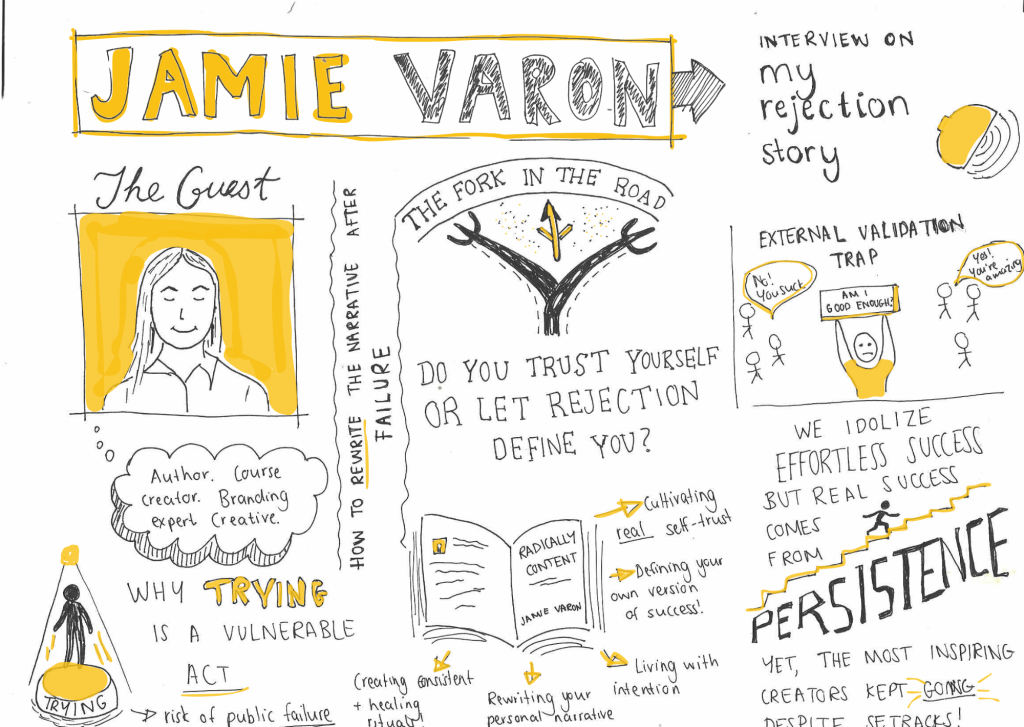
Why is it so terrifying to truly try? According to writer and creative entrepreneur Jamie Varon, it’s because trying means opening yourself up to rejection. It’s easier to self-reject, to stay small, to convince yourself you didn’t really want it anyway. But what if the real risk isn’t rejection—it’s never trying at all?
In this episode, Jamie and Alice unpack the deep emotional weight of putting yourself out there. They explore why self-rejection is often the biggest hurdle, how social media tricks us into idolizing effortless success, and what happens when you stop chasing external validation and start trusting yourself instead. Jamie shares the raw reality of her own career—the disappointments, the setbacks, and the turning point when she finally decided to stop letting rejection define her.
If you’ve ever struggled with self-doubt or felt like giving up, this episode is your reminder that the only way forward is through.
For anyone listening, you can order a copy of Main Character Energy on Amazon: https://a.co/d/hONnwpF
I will also be giving away a copy to a listener who subscribes and reviews the podcast. You just need to email screenshots to media@hustlingwriters.com.
A special thanks to our partners, who I highly recommend getting in touch with.
If you are looking for a book writing coach to get your manuscript out there, I recommend working with:
Lindy Pfeil, Author and Memoir Coach, website: lindypfeil.com
Emily Tamayo Maher, Author & bestselling author in women’s spirituality, website: meaningmethod.com
Tracy Stewart, book mentor and developmental editor, author, and ghostwriter, website: freshlypress.com
Javacia Harris Bowser, host of a community for female writers, bloggers, and entrepreneurs, website: seejanewritebham.com
If you are interested in exploring hybrid publishing, I highly recommend getting in touch with Nick Courtright, CEO of atmospherepress.com
If you’re looking for a brain / neuro trainer, check out Paula Echeverri, website: neuromomceo.com
Find Jamie Varon Online:
Read Jamie’s Books:
Radically Content: Being Satisfied in an Endlessly Dissatisfied World
https://www.amazon.com/Radically-Content-Satisfied-Endlessly-Dissatisfied/dp/B09VY6CLR6
Main Character Energy
https://www.amazon.com/Main-Character-Energy-Jamie-Varon/dp/0778334201/
Jamie’s Website:
https://www.jamievaron.com
Follow Jamie on Instagram:
https://www.instagram.com/jamievaron
Chapters:
00:00 The Fear of Self-Rejection
05:27 Rewriting the Narrative After Failure
12:45 Why Trying is a Vulnerable Act
18:32 The External Validation Trap
24:51 Effortless Success is a Myth—Here’s the Reality
30:16 Building a Career on Resilience, Not Luck
37:04 Radically Opting Out of Societal Conditioning
43:18 The Fork in the Road: Do You Keep Going or Let Rejection Win
Without you, this show wouldn’t be here. If you want to help us reach even MORE people, than please subscribe and review. Thank you so much!
00:00 The Fear of Self-Rejection
05:27 Rewriting the Narrative After Failure
12:45 Why Trying is a Vulnerable Act
18:32 The External Validation Trap
24:51 Effortless Success is a Myth—Here’s the Reality
30:16 Building a Career on Resilience, Not Luck
37:04 Radically Opting Out of Societal Conditioning
43:18 The Fork in the Road: Do You Keep Going or Let Rejection Win?
Alice Draper (00:00)
Jamie, welcome to my rejection story.
Jamie (00:04)
Thank you for having me, I’m excited to chat.
Alice Draper (00:07)
Before we dive into the conversation, there is so much I want to chat to you about. Do you mind introducing yourself to the audience? Who are you? What do you do? A little bit about your work.
Jamie (00:18)
Yeah, of course. My name is Jamie Varon. I live in Los Angeles, specifically in Calabasas. I’m an author and I’m also a course creator, branding expert, graphic designer, creative consultant. So just a multi-passionate type of person. But mostly the focus right now is on writing books, specifically novels.
Alice Draper (00:46)
Thank you so much. You wrote a quote in your book that said something along the lines of some people let rejection be redirection and other people let it be an incontrovertible truth about themselves that almost defines them. Talk to me about this. What does this mean?
Jamie (01:05)
To me it means you can either look at a rejection as it’s not meant for you, it’s not the right opportunity, the right person, the right thing, or you can take it as this says something about me and my worth as a person. So if X doesn’t want me, X person doesn’t want me, this opportunity doesn’t want me, I must not be good enough or worthy or instead of just saying the right things will come to me whenever they’re meant to be. And if something is a rejection or even a failure, it is just that I was meant to learn something, which eventually I think leads people to be a lot more, just a lot less fixated on things going a certain way. Because if you look at anyone’s story, like anyone that you would look up to, you see that things don’t usually go, they might have a plan, but it doesn’t go according to the exact plan that they thought. And there’s been many pivots, many redirections, many times where they thought it would happen and then 10 years later it actually happened. And then they look back and go, wow, I learned so much. I was so much more prepared for the opportunity when it came to me. So for me, even if a rejection, is like a low blow and it hurts. And of course I have to process that pain. Eventually I get to the place where I go, well, it just wasn’t meant to be. And I have attached a story to it that it was supposed to go that way when it really wasn’t meant to go that way. And I am only future casting. Like I’m imagining that this opportunity would have led to X, Y, and Z things that I think I should have or should experience.
And it’s like, eventually I get to the place where I’m like, how did I know? How would I know that? Like, I’m just imagining it and thinking that I know how it all works. And I’ve just been shown so many times that it’s like, I don’t know how it all works. I don’t know how it can all come together. So for me, it starts with that feeling of there is no rejection, really. It’s only about seeing that.
If there is a rejection, it wasn’t meant to be in your path. And it’s about then evaluating what did I think this was going to bring? And am I going to let myself believe that that is the only way that I can get the result that I want? And therefore cutting myself off from all the other many ways that it could come into being of us.
Alice Draper (03:48)
When you talk about, you know, that that rejection’s saying something about your worth, I get the sense that maybe, and also having you read your work, there was a time when that’s how you would have interpreted a no, a rejection of some sort.
Is there a specific instance that you remember that started shifting the way you look at this and helped you gain that perspective that it’s it is just that redirection. It’s not an incontrovertible truth about you and your worth in this world.
Jamie (04:20)
Absolutely, mean so many but I think that it started with me recognizing many years ago that my fear of rejection which was very very very large and it loomed very large in my life was keeping me from doing the things that I really wanted to do. It wasn’t that I wasn’t good enough, that I wasn’t this, that I wasn’t that, all the things that I believed that were just a story I was telling myself it was the fear of being rejected and what I would make that rejection mean. And so when I eventually started, you know, actually going after the things that I wanted and then getting rejected, you know, I mean, I had book proposals that were being sent to editors from my agent at the time that were being rejected like 15 in a row, just no, no, no, no, no. And I was like, well, this is a perfect test of whether I’m going to believe that that means I’m not good enough and this path isn’t meant for me, or if I’m going to dig a little deeper and get to kind of that self-belief that can’t be taken by rejection. And I’m not saying that that happened like overnight. I wasn’t like, you know what? I get it. It actually took a while for me to get over those rejections just because it was like, this is my worst fear manifesting which was then another thing that I had to look out of like, well, good, my worst fear just got manifested. Maybe I shouldn’t be, maybe I should look at my worst fears and try to have them have less of a hold over me as I continue with this process. the more, actually the more I got rejected, the more that I failed, the more that I tried things that didn’t work out. And I was like, I’m fine. Like I didn’t die, I’m okay, I can work through it. The braver I got.
Alice Draper (06:19)
So it’s really that doing hard things builds that muscle memory that you can survive hard things. And in this case, it was getting rejected. There’s another quote, I think you wrote it in your book, Radically Consent, where you said, there’s a different kind of disappointment, the kind born from inaction. And that’s the kind that crystallizes into regret. And I like highlighted that and sort of really wanted to bring it forward to this conversation because that’s a big reason why
I want to talk about rejection. I think that the worst kind of rejection that exists is self-rejection, which is the rejection born from inaction. And as you said, the one that crystallizes into regret when we look back at our lives, whereas we’re less likely to be regretful of the times other people, other institutions or whatever rejected us because we knew that we did what we could.
So yeah, I wonder if you could offer some insights into that and how you moved out of that space of inaction and if that’s something you still work on, there still practices you put into place to not self-sense or self-reject yourself?
Jamie (07:26)
Honestly, after experiencing what it felt like when I was not taking action and how draining that was, I now honestly never struggle with inaction anymore because I just know the alternative. And it’s more about now I evaluate whether something is worth taking action on. I spend more time doing that instead of I’m afraid, like I now know how to take action because I see even when I take like the first step, I know I’m going to be scared. I know doubts going to come up and I just focus on, okay, just keep going because I know for a fact with my own experience that the doubt will not go away if I stop. Like the doubt actually magnifies and gets, excuse me, gets like a million times worse when I stop. Like if I have a day, say I’m like writing something new and I have a day where the doubts are really, really loud and I’ve had those many days like that, the worst possible thing I could do is not write the next day because then I’ve allowed my fear to actually, I’ve given it more space in my life. I’ve actually validated the fear in a way and I’ve said to myself, yeah, that’s a reason to stop.
And then that becomes a really terrible habit. And that becomes a habit that could take years to break yet again. And so I never allow that. I tell myself, I sit down and I write like the worst 500 words that I could ever think to write if I need to. And then I just keep going because I know that there’s days where it flows and days where the doubt is stronger and I cannot give any air or weight to the days where that doubt is so strong and then make that lead me to inaction because I know how much how much I look back on like my teens and 20s of the times where I didn’t take action and I do feel regret and I have to live with that now. You know I’m I turned 40 this year.
It’s a really big milestone to think about all the ways that things worked, what didn’t work, what I wanna take into that new chapter of my life, into my 40s. And I’m like, I look back at those times where I didn’t take action, where I let fear get the best of me. And sincerely, those are the times I regret the most. I just know, I just keep that in the top of my mind so I don’t allow myself to…look back, I don’t allow myself to think too long in the what if. If I want to do something, I do it. And, you know, now it’s just a matter of because I’m so capable now of keeping to my habits and doing all of it, it’s now about trying to figure out what are the best courses of action, which is a nice place to be in because it wasn’t always that way. It was more like how am gonna figure out how to do this consistently? How am I gonna be able to do this? Because the other thing is is that if you don’t trust and know that you can take action consistently, your dreams will get smaller. Because any dream you have, it’s for the most part, you’re not gonna be able to act on it in a week or a month. It’s gonna take a long term consistency, a long term endurance, a long term of taking action even when it’s boring, even when you don’t want to, especially when you don’t want to, that’s the most important time to take action. And so you end up making your dreams a lot smaller and your vision a lot narrower, even subconsciously, because you don’t know how to take that action. You don’t know how to keep yourself motivated, how to keep yourself consistent.
And once you do, once you figure that out for yourself, I mean, everyone has a different program. Everyone has a different kind of way of who they listen to, who they see, who they resonate with. That’s how it’s meant to be. Once you figure that out, all of a sudden your dreams can feel a lot bigger because you know you can take action on them. You know, I mean, for me, it was always hard for me to fathom a career as a novelist because I was like, how do I write a book?
Like I can’t even write every day at that time. And now, you know, having so much evidence that I can write when I need to be able to write, I can write consistently. I can write and meet deadlines. I can be creative on cue. All of this. I’m like, now I feel like I have the sort of confidence to go after this dream because, you know, confidence.
There’s a lot of confidence in your thoughts, in your feelings. I absolutely believe that. I believe in changing your mindset, but I also believe that there’s confidence that’s built in taking action and knowing that you can trust yourself and keep your word to yourself.
Alice Draper (12:50)
Yeah, I absolutely agree. You actually have a quote in your book of Action Curiosphere, something that I quoted out of your book, and it makes me think of an analogy, an actual metaphor. I mean, I use it as a metaphor, but it’s actually something that my parents used to talk about because they were both horse riders, is if you get thrown off a horse, you have to get back on the horse straight away. Because if you don’t get back on the horse straight away, you might never get back on the horse.
And from what I’m hearing, it’s something similar with facing any kind of professional setback. The quicker you get back into the action mode, the doing mode, the quicker you, the more confidence you build in yourself. I 100 % agree with that. Something you touched on earlier is that you have to evaluate what’s worth taking action on. And now, you know, the problems you face is knowing what are the best causes of action.
What does that look like for you now, and how do you make those evaluations?
Jamie (13:51)
Yeah, I think for me, it’s like kind of a spiritual process of, know, am I doing this out of fear or I think I need to or I should, or it’s like from lack or scarcity or I’m so scared that this is not going to work out. So I better do this other thing. And then I know from from doing that other thing that It just never, it never does what I think it’s gonna do. Like it’s not gonna be the plan B that I think it’s gonna be. And so my thing is really coming back to what do I really wanna do? What am I really being called to do? Because fear, when you stand up to fear, can start, fear starts getting really sneaky. It starts coming in in very different ways. It’ll convince you that, well, you should just be realistic.
So you gotta do this and you gotta have a backup plan and you see that thing, you gotta have this, you gotta have this, even when my intuition is telling me something totally different and it requires faith, it requires me to believe in something bigger than I’ve been able to believe in before when it comes to what I see myself capable of. And so I really have to evaluate the actions that I’m taking because I can be very, there’s, things, I have to do it for the right reasons or at least for the reason I, not that there’s right or wrong reasons, but the right reasons for the season I’m in and what my ultimate vision is, because it can be very easy to be thinking very short term when you need to be thinking long term. It can be easy to focus on what you think you need right now versus what is going to set you up for success later. because a lot of things, especially in creative work, A lot of things are investments, they’re time investments. And you’re not always seeing instant results, whereas we’re in a world that loves instant results, that wants instant gratification, that wants to see something go viral right away, or don’t keep doing it, or it’s not working, or if the first thing doesn’t hit, then you better choose something else. And so I have to really evaluate my actions based on my longer term vision, as opposed to… what I think is the short term need that I have that that’s a trap that I’ve fallen into in the past. And because I didn’t put in that time for my longer term vision, I felt like I was more behind than I wanted to be at certain times in my career. that’s really my evaluation process is mindset first before the action, getting clear before the action.
You know, now that I don’t question myself on whether I can take the action, now it’s about evaluating what is worth my time, like I said, and that evaluation process is more feeling, more like emotion-based and more about thinking further than, yeah, what I think I need right now that would validate something that I feel I’m lacking. And it’s like, no, I validate myself now.
I feel good now, I am happy now, I’m fulfilled now, and now what? But now what? Instead of trying to fulfill a void, which like, you know, fill a void which doesn’t exist, but I’ve made it, I’ve thought that it exists.
Alice Draper (17:24)
Yeah, yeah. I think that delaying that instant gratification is probably one of the most important and most challenging things for any big creative endeavor and probably something that holds a lot of people back. Maybe just because when you don’t see instant results, you assume things are not working. And often with a big project, a big, like a book or growing any kind of creative growing business the gratification is going to be delayed. You have to be consistent and you have to consistently put that time in. What advice do you have for people who struggle to stick to something, especially when they’re not seeing the results yet that they were hoping to seeing or not getting that gratification yet?
Jamie (18:13)
Well, mean honestly even when you get the gratification and the results it’s not as motivating as people think so that’s the first thing like if you’re not motivated by more than the results It’s gonna yeah, you’re gonna burn out really easily like you’re gonna burn out You’re gonna start strong then you’re gonna get not motivated because you’re gonna go up and down from day to day by who’s paying attention what results you’re getting like ultimately It is a cliche for reason, but the process is the whole point. Like the journey is the reward. Honestly, if, if like, if you’re doing a creative endeavor and the journey does not excite you and it doesn’t make you happy, then the results are going to come, they’re going to be so such a letdown. I hate to say it because it’s just tough love, but it’s, they’re such a letdown. you wait years and suffer to get something. Like that’s why people say it doesn’t come out the other side. Like it doesn’t make it worth it. Personally for me, I don’t know, maybe some people they like the suffering. You know, I guess I can’t speak for everyone, but that would be my advice is, you know, learn how to love the process and see the reward of the process because eventually when you do get those results, You look back on the process as the most rewarding part because the result of something is like a minute and then you’re already used to it and it’s already happened and it’s already done. Whereas you might’ve spent two years getting to that one minute and wouldn’t it be better if those two years were spent joyously and it and being excited even by challenges and being excited to get better and progress. I mean, To me, that’s the secret and it’s not as sexy as, yeah, like hustle until you get the thing. But it’s like, I just don’t see that as the rewarding part. you know, as much as I have big dreams and I want big results and I want, I have such an ambition, I also always have to remind myself, like, if I’m not enjoying the process, if I don’t find the whole entire even the waiting, the agonizing waiting, if I don’t find that at least somewhat enjoyable, because it means I’m doing it. I’m not just waiting around for myself to get it together. I’m waiting around for the fruits of my labor to come into being. If I could see that as even the positive and such a joyous part of the process, then like I already won, you know, then the results, they can be what they are. You know, if like, say, say like a book doesn’t exceed my expectations or something. The reception doesn’t exceed my expectations. It’s like, okay, then I get to write another, I write another book. Like, okay, I get back into the process of writing another book. Either way, like say a book does exceed my expectations. What you’re gonna do is write another book anyway. That’s what everyone’s gonna want from you is another book. So it’s like either way, your success or failure, you still have to do the thing. And so it’s like the result, I think people think the result is going to give them validation or permission that they’re good enough that they get to do this. So they’re waiting around for that. Whereas to me, I’m like, you give that to yourself. Look at every single artist that like is so amazing and you look up to, they’ve had to withstand like Chapel Roan, for example, everyone’s talking about Chapel Roan because Her story is just a beautiful story of perseverance, like drop from her label. Nobody got her music. Nobody understood her. But in those times, if she said, you know what? Obviously, you have to love making music to keep going when you get dropped from a label. That’s the worst nightmare of an artist is to get a label deal and then to get dropped from a label. But you have to love what you’re doing. You have to have that vision. Otherwise, I mean, you’ll be in the like rough and tumble cycle of a, you know, it’ll, it’ll beat you up because there’s so many times where it usually doesn’t go your way. And then the times that it does, then you’re worried about holding onto it and you can’t like, you just don’t have that flexibility. So for me, it’s like the results, I just let those go as much as I can, as much as I can, even when I have such big dreams, I have to get in the day to day of just like, you know, doing my work because I’ve had so many of the results I’ve dreamed of and they don’t give me the permission and the validation forever. Like they’re a moment in time and then I still have to just wrestle with myself and deal with myself and get into states of positive expectation and surrender and then I can do my work.
Alice Draper (23:29)
Yeah, I completely agree with you. I think that getting too caught up in the results can be a very unfulfilling, yeah, an unfulfilling journey. And if you think of writing a book, if you think of… starting a podcast, starting a business. If we’re not loving the process, which is you’re spending most of your time in the process, you’re not spending most of your time in the results phase, not only is that a long time to not be happy, but also I think that the people can pick up on it if people are going to, you know, back your book or… support your business venture or want to work with you or whatever it is and they can sense that you’re doing this for some kind of gratification in the end and not because you’re loving what you’re doing right now. As you said, it’s probably less likely to be successful and harder to be resilient. So the example of Chappell Rhone. To shift gears a little bit, in one of your newsletters you titled the subject line, trying is a vulnerable thing and I really related to this, something that you wrote in the newsletter is, it is profoundly vulnerable to have hope to really try to give something a shot when all evidence to the contrary has told you that nothing works and nothing will ever work. I honor that worry and I honor that self-help has burned people a lot in the past, giving them false promises of huge changes. This just, I wanted to talk about because I think that.. when people do find that thing that they can really stick to through that journey and before there’s the results, it still feels vulnerable. I think when it really means something to you and it’s not something you’re just doing for results, but doing something because of whatever that, why is that mission is, it can feel very vulnerable putting yourself out there in that way. What has that journey been like for you as a creator? Is that something you still struggle with?
Jamie (25:28)
I mean, as I started doing more of the things that I really cared about, like truly, truly felt like my purpose on this earth, I felt more vulnerable. And I was like, man, that’s a plot twist. I thought I’d feel like exhilarated. I’m doing it. I got the book deals. And then I ended up feeling more vulnerable, more scared, more. And I was like, this has got to be a joke. Because I really think that, Honestly, if we look at the trend and pattern of people, we do kind of think it’s, we don’t want to see people trying. We love the idea of things being sort of effortless. I think because we want it to be effortless, you know, like as people. And so we want to see that. But like I find seeing people trying and seeing people get up even after they’ve been, you know, thrown from the horse, you know, in a way it’s like, that to me is so much more inspiring. Like I don’t really relate and get inspired by people who are like, yeah, so I just like tried once and it all just worked out and then I was good and then I’m just continuing to be good. Like I’m like good for them if that’s really true. But I think resiliency is so cool to witness. think watching people who are trying even when They don’t feel that there’s been any evidence to suggest that they should be trying. I find that incredibly cool. I think that I see that more and more in the artists that I admire, that there comes a turning point and sort of a, well, I would say probably like a fork in the road where they have to either believe what the world is telling them about their work or they have to believe their own inner voice and the vision that they have for their work.
And that is a very important fork in the road. And a lot of people go in the, I’m gonna believe what the world is saying. If it hasn’t worked, it doesn’t mean, it means that I’m, it’s not working and I need to give up. And they do that at like 22. And I’m like, you can’t, I mean, I just know, I’ve seen it. I see it even more so with the way social media is now where people think like, if I’m not viral, like immediately, it means that’s like all the proof that I need. Whereas like, People who take the other fork in the road, they take that other path and they say, I’m gonna ignore absolutely every reality that is presented to me right now and I’m gonna live in the reality in my mind where I am, all the things that I have imagined are coming true. I know my vision, I’m gonna keep working, I’m gonna put my head down. I am not gonna live in what is, I’m gonna live in what is coming and what is available for me and those people win Grammys. You know, those are the people that win Grammys. Like, I mean, really, it’s those are always the stories. Like I, I’ve come to now look for that in people’s stories and the artists that I look up to and the ones that I admire. I always hear whether they’re using the words or not. I always hear that fork in the road where they had to say,
Alice Draper (28:21)
Yeah.
Jamie (28:44)
I’m not listening to what the world tells me about my work or about my vision. I’m going to believe audaciously in my vision and be patient and stay on my track. And if you start paying attention to people, if you listen to interviews with artists or anyone on a creative journey, any entrepreneur, anyone who took a chance on their work, that fork in the road is in every story. It’s just, they say it differently every time but the fork in the road is there where they have to go. I I read a book by a woman who, she started a huge makeup brand, Inc, think, INC. And her whole thing was to show women with natural texture on their, like not to airbrush, you know? So when she did marketing, wasn’t airbrushed skin. It was like real texture on the models. And that was a big part of her thing And everyone, every place rejected her. It’s never going to work. No one wants that. And then she built a billion dollar makeup brand because she said, no, I know people want this. Even when people were saying to her face, you’re not going to be successful. And it’s like, that’s the fork in the road again. And the people who don’t believe everyone’s nay saying, I really think they’re the ones that, our triumphant, not to say that like, you know, a billion, don’t have to build a billion dollar business, but just like your own fulfillment in whatever way you want that fulfillment to come. It’s like, you have to trust in your vision. Otherwise immediately the world will break you down. It’s almost designed to break you down. So it’s like, if you don’t trust in your vision, assuming that something outside of you needs to prove to you or give you permission to trust in your vision.
I did that for a long time. Man, it got me nowhere. The moment I started trusting in my own vision, actual movement, actual true movement.
Alice Draper (30:51)
so much and I completely agree with you. think seeing people, especially seeing them in that process of being absolutely convicted with their work is just really nice to watch. I recently came across an Instagram account of a South African, I’m from South Africa singer and I think she’s great. mean I think she sounds to me like her music is stuff I could listen to pop music similar to Olivia Rodrigo but she is maybe has like 10,000, 14,000 followers and she just posts these videos every single day, like of her singing her song in public, getting like people to try sing her song with her in public and there’s just multiple videos all the time and she just has this conviction of getting her, like getting a record deal out there. And I can imagine like sort of the battle that it is to show up every single day when you know that you’re not where you want to be yet, but you have this conviction and I think with any creative endeavor, whether it’s being an artist, being a writer, even starting a business, is that the arts are stacked against you. You have to be able to put in those reps over and over again and be more consistent than other people in fine tuning your craft to be the one that gets known in that craft, whatever that craft is.
Jamie (32:18)
Absolutely, and like honestly, I mean The thing is, that like that consistency, I mean, people want something outside of themselves, like a label or a publisher or something to tell them, yes, you’re right to have conviction, but that’s not, that actually doesn’t work. Like they’ll show up, maybe not right away, but they’ll show up more likely when you have that conviction yourself and you, and you’re like, I didn’t need it from you, but I’ll take it. Like I’ll take your support Instead of like, I think the worst thing you can possibly do is put all of your conviction and all of your belief into something outside of you. Because what about the moment that they don’t pay as much attention to you? What about the moment that they find someone else that they’re going to put some support into? I mean, there’s so many ways that that attention can ebb and flow. And so if you’ve got all your conviction in yourself put into an external source, it is so flimsy. And that actually is painful. Like that’s painful. So I would rather personally build up my self-conviction just so I’m not that vulnerable to the whims and, you know, I mean, people are fickle. Labels are fickle. Publishers are fickle. The world is fickle. They love you one minute. I mean, we have, Taylor Swift is coming off of two years of… being probably the biggest celebrity in the entire world. yesterday’s Super Bowl, she’s getting booed. I mean, it’s just, and I’m not saying that that’s cool. I’m just saying that like, people are fickle, you know? So if you’ve got all your self-belief, all your worth, all your value in what other people think, no matter who they are, even if you think they’re the decision makers to end all decision makers. I mean, do you know how many decision makers have been wrong about things? So many times, so many times. I mean, we’ve heard it a million times. So I just look at all of that and I see how important it is. I’ve never ever looked at someone’s journey that I look up to and I saw like, wow, they really just like put all their eggs into the basket of external opinion. They never do. They did it for like their own conviction.
Alice Draper (34:45)
Yeah.
Jamie (34:49)
And so it’s like, when you look at it that way, it’s not just, if you believe in yourself, it’ll happen. It’s more like, this is actually how you survive, how you thrive. It’s not like, and we think something outside of us is the thing that’s gonna make us strive or give us that good feeling. And it just so often doesn’t. In fact, we get it and we go, man, that’s a little emptier than I thought it was gonna be. Dang it. And so.
You can either look at that as that is proof that I need to have it all inside of me and get right within. Or you can say, like some people do, well, I guess I just need more and that’ll fix it.
Alice Draper (35:36)
Yeah, I love that you touched on this. I think that working on that self-conviction is probably the most important foundation step that any of us can take as a creator. And I think that it can be a very dangerous path if it’s not there. If you’re building something based entirely on external validation, as you’ve touched on, it can be not rewarding. And I think it might be part of the reason where…
artists have really struggled and been really lonely and had to turn to things like substance abuse might be because they didn’t have that self-conviction and so all that external validation ended up doing nothing. What about you? How did you build self-conviction? I I read in your book that you didn’t have a great time in high school. In school you were bullied and things started changing when you were traveling Europe, I think. Yeah, so what is some of your story and how you built that self-conviction?
Jamie (36:41)
that has definitely been a journey. Every time I think I have the self belief and conviction down something, there’s levels to it. There’s levels to it because you can have it when nothing’s going on and then something happens that then can kind of rock your world a little bit. And you’re like, even a good thing happening can kind of rock your world a little bit. So my process has been to really recognize my desire, my absolute desire for external validation, how much I yearn for it. And so I’ve had to really, really unpack that because it’s true. I have, I’ve always wanted to be noticed and recognized and seen and I… I feel that as an artist, it’s completely beautiful. Like, of course, I want my books to be read by millions of people. I want my work to resonate and to, you know, be seen. I want to be acknowledged for the work that I do, but not from a place of like lack, which is what it has been in the past. So my process of coming to my personal conviction has been out of necessity because I don’t, I can’t do the other thing anymore, you know, to have to have books come out, to have things happen in my life that are so exciting and so fun, but then have so much anxiety about them and then having, you know, measuring them and deciding if it was good enough or not. I was like, that’s it. I can’t do that anymore. Or having something happen and then, you know, thinking that that’s going to be the thing and then it doesn’t happen. mean, you know, once you get on the journey, there’s I mean, there’s more rejection, I feel like, because you’re out there more and you’re doing more. And so that’s that, like I said, that conviction has come out from necessity because I was just up and down all the time. And, you know, I was waiting, I think with my first novel with main character energy, I was waiting for all the little milestones to make me feel good enough. You know, I was like, okay, my the agent that picked me out of the slush pile, that’ll do it. Nope. Okay, what about if I get a book deal with a big five publisher for my novel that I thought that would be impossible? That’ll do it. Nope. You know, like all these things that I thought that’s gonna be the thing. And then to realize that sure, they’re little like blips of excitement and I’m not gonna downplay that, it’s exciting but it doesn’t sustain. I was like, damn, like that is so disappointing. And so I really had to look at what do I think I’m going to get with this external validation that I crave so much? You know, what do I think is it, do I think it’s going to make up for my painful past or the way I was rejected when I was a teenager or, you know, it’s going to prove the bully wrong, the bullies wrong. I mean, none of this matters, no one cares, no one’s looking, no one’s, you know, so it’s like, I really had to look at that. And then, you know, I think that that comes down to that fork in the road again of like, you’re either going to be the type of person who thinks, I just need to get more and more success to finally prove to myself I’m good enough. The fact that I’m not, don’t feel good enough means I haven’t gotten enough success, which is a trap. Or I’m going to say like, I’m just going to do it with total conviction in myself, believe in my vision. And every time something happens, that’s amazing. I just keep creating a new excitement. create creating a new dream. And that’s, that’s more exciting to me. It’s like, what joyful experience do I want next? What am I manifesting next? And to me, that’s a lot more peaceful. And so that’s how I came to that. And I think There was a lot of work on that last year because I had to write my second novel under contract with a publisher on a deadline. And I was like, well, this will be the ultimate test if I can do this because there’s a past version of me that would have never, ever, ever been able to do that. Like I would have crumbled and I wouldn’t have felt good enough. So I had to have my own conviction.
Alice Draper (41:20)
Yeah.
Jamie (41:26)
and I had to believe in myself every single day to write that and that built it up, know, it really built it up. So now I feel, now I feel like I get it. I get it now. I’m like, okay, because if I don’t have my back, I’m waiting on something and I don’t wanna wait anymore. Like this is my life, you know, I don’t wanna wait to feel good enough. I’m just gonna decide that I am and give myself permission to believe in my vision and to know that there are forces conspiring for my good at all times and sit back and enjoy the process and watch it all unfold. And that sounds better to me than, I need more, I’m still not good enough, when will it ever, like all of that striving and lack and scarcity. just like, I’m not interested in it anymore. I don’t think it got me anywhere.
I lived in that for a long time. It didn’t really do anything for me. So, you know, I don’t know, for some people maybe they are motivated by that, but man, it is not my place of motivation. That shuts me down so fast.
Alice Draper (42:40)
I really appreciate that this is something that you talk about and have written about because yeah, that space of being from that place of lack, not enough or feeling like there’s so much you have to prove wrong from your post high school experience versus now where it’s coming from what I’m hearing a place of contentment, radically content, abundance.
I want to know if you have a specific fork in the road story where it shifted from that place of lack to this place of being content with where you are at and creating on top of that. I know that for myself that shifted when, for some, it’s kind of a long story, but moving home to look after my dad with dementia shifted the way I looked at rejection going through a period of difficulty and grief and loss.
I no longer was so deathly afraid of rejection coming out of that. And that really changed things in the way that I showed up as a creator and a business owner. I wonder if for you, was there a specific point in time where you noticed that intense shift in yourself and the way that you put yourself out there in the world?
Jamie (43:55)
one I can think of the most, mean, there’s been several, I feel like, but the one that I can think of the most is that with my novel Main Character Energy that came out September 2023, debut novel, it was like my debut year was a comedy of errors. Like it was everything that I had feared. It was a perfect manifestation of all my fears. So I was like, wow, I’m a really powerful manifesto because I manifested all my fears. So now I’m I was like, okay, good reminder to now manifest the good things that you want and not your fears, because I’m really powerful. But it was it was a comedy of errors. There were like, everything that I thought I worried would go wrong on my when my first novel came out did it also just there’s a lot of cool things that are happening in the background with main character energy. But in terms of like sales and not getting on a best seller list and you know, all of that. I was, I was devastated. You know, I was sad. Like, you want your debut year to really be a splash. And I had to do a lot of that fork in the road thinking of how much did I contribute to this with my fear? How much did I like, I, I thought.
There were just a lot of things, but that was a big moment for me because a part of me really wanted to give up. Like I wanted to slink away and give up and not write another book and not put myself out there. Like I thought that was my proof, you know, like for a good amount of time, I was like, that’s my proof. I’m not a good enough novelist. I’m, this is not going to work. I need to come up with other ideas and I’m so glad that I just like said to myself, eventually I was like, okay, well, I have to just write the next thing. That is the next thing that I do. I write the next thing instead of, know, would it have been nice to have had a massive phenomenon bestseller? Yeah, but you know what? I’ve heard from a lot of people who’ve had that then to follow it up is so debilitating that writing the next thing is so hard, almost so hard that they don’t do it. Like there’s a lot of people who write one really big debut novel and we don’t hear from them again. They don’t write anymore. I mean, I could think of several off the top of my head right now. And so I was like, okay, let’s not assume that the thing I wanted would have been the thing that would have made me so, happy. It could have gotten in my head. It could have made me, you know, I wasn’t really that totally strong in my ability to write novels at that point. I was still searching for validation. I was still thinking, well, I guess my editor really liked it. And the fact that I got a book deal must mean I’m doing pretty good at this instead of like when I wrote the book that’s coming out in September of this year.
When I wrote that book, I had such conviction in myself. Like it was a totally different process. I was not, I’m just like, I wrote it because I love this. I love the process of writing this. So that was my fork in the road of saying to myself, you know, I could either take this as total, that’s it. That’s the answer that I’ve been looking for. That’s my evidence. I’m not good enough. There’s no point in doing this Or I could believe in my vision and my conviction in that I’m meant to do this. I keep gravitating to this. I can’t stop thinking about it. So I must do it. And that was that’s the one that I could think of most recently. And that was a big one, because to me, being able to really pull myself up from what I believed at the time was like such a failure to myself and then to come out the other side and be like excited about the next thing. I was like, this is, this is it. Like this is the secret that I’ve been looking for. It’s not, the secret isn’t everything better go according to my plan or I’m gonna lose it. That’s not the secret. The secret is like, I’m gonna be cool. I’m gonna be good. I’m gonna be happy no matter what happens. Like I’m just gonna.
If I have to process some stuff, I have to process some stuff. Okay. All right. But like the secret is not, man, this better go exactly how I expected to go or I’m out. It’s like, but that’s how I lived for so long. I mean, I really put that high expectation on myself and it was not conducive to like doing my best work at all.
Alice Draper (49:15)
Yeah, yeah. If only we could control things in that way.
Jamie (49:19)
I mean, yeah, if I could figure out how to control it all and I knew the plan and I could okay if I could control how everything is received in the world Yeah, but we know we can’t and so, you know that that was a really big lesson for me and and now something that I Truly thought was like world ending I’m now so thankful that it happened because I’m like, it exposed all the cracks in my thinking and all the limiting beliefs that I still had, all the fears that I still had, all the ways that I was still searching for something outside of myself to give me permission to do this. And so it was actually a really valuable experience that was not at the time very valuable, didn’t feel very valuable at the time.
Alice Draper (50:13)
using that feedback to change how you approach the book writing process for your new novel that’s coming out and can you share anything about the new novel?
Jamie (50:22)
I’m not sharing anything yet, but hopefully soon once the cover is done and we’re planning on everything. basically, mean, the thing is, is that you can’t take feedback too seriously because you just never know in terms of like, you know, concrete feedback or like something that someone said on Goodreads or whatnot. Like you can’t take it too seriously because like you just don’t know.
What is, why something connects over something else? You know, there’s some sort of like magic that happens. And so what actually I took into when I wrote this next novel that’s coming out, I was like, if I’m, what I want to know, what I want to feel when this book comes out is that I wrote it based on what I wanted to write.
Like I didn’t write it based on what’s popular and the link, like what’s right now and really hip or whatever. I just wrote what I felt my soul wanted to write, you know? And I did some really interesting things with structure, with different formatting, different things that I hadn’t seen in a lot of books. And I was like, I’m just gonna trust it. I’m gonna trust it. And what ended up happening is like actually the craziest thing. I mean, I basically… to my editor at my publisher turned in like my first draft. Like I didn’t do a lot of editing on my first draft. And she was like, this is awesome. Like she had like a page of notes for me. And I was like, okay. So when I really trust myself, when I really, really trust myself and I get to that place, you know, and I’m not expect, I don’t know if that’s going to happen every time I’m not. And that, that was the thing too. I was like not hoping for that. I was just like, If I need to work on this book more, if I need to revise it again, I will. Of course, I did revise it. You always have to revise it. you know, it just, it really taught me that lesson that when I’m tuned into myself, when I’m not looking for anything outside of myself, when I’m like listening to my intuition, when I’m writing something that I know is exactly what I want to write, not what I should, what I think, like, I’m not overthinking it. It works. Like I’m so proud of this book. I was really proud of main character energy, but it’s a different pride for this book, because I felt like it was like the most me. Like it was the edge of my ability as a writer. Like I pushed myself in things that I didn’t know I was going to be able to pull off. And like that really excited me versus trying to write a perfect book that nobody ever dislikes and trying to impress everyone else, I’m like, well, good luck. I I’m like, I’ll try it, but it’s not gonna work. So, you know, that was a really rewarding experience actually.
Alice Draper (53:27)
As you talk about this, it makes me so excited to read the book because I think that you had such a beautiful description and pushed the edge of my ability as a writer. And I can imagine that, you know, allowing yourself to be messy and perfect is probably where rarely powerful writing shows up. And contrast to trying to over perfect or over control the writing process. So yeah, I’m really excited for that.
What is your, my second to last question for this interview, what is your relationship with rejection like now?
Jamie (54:03)
I actually love it because it gets me on a high because I’m like I’m actually trying. out there. You know, like and I’ve had at least in the past like few months several pretty not great rejections and I’ve loved my reaction to them. I’m like, okay.
Alice Draper (54:05)
Love that.
Jamie (54:25)
Not a fit, not working, not working out, good lesson. And honestly, I feel like there’s probably some things that are happening in my life that if I got rejected, they would be very hard. But I still think, I still know I would be OK. Like even over the summer, there was something that I can’t announce yet, but there was a contract that I was meant to sign and it almost fell through. Like it was a code red situation where like all of my team was talking. We were like, what are we going to do? And I mean, I definitely cried. And then I was like, if it’s meant to be, it’ll be like, if it’s not, then I cannot assume that I know how this was meant to go.
Like I cannot assume that, that would have been it. Like I had to trust. I was like, if there’s something better or there’s something that I’m not seeing, like there’s just something. And then it ended up going through, you know, but I didn’t know it was going to go through at that moment. So I was really proud of myself genuinely. wasn’t like, you know, sometimes you kind of like tell yourself, and you’re a little lying to yourself, it’s okay. You’re kind of faking it until you get there. This one was not a fake. I was actually truly at peace with it. And I slept that night, you know, I was fine. And I didn’t worry about it because ultimately I don’t want to force things in my life, you know, especially big things, especially things where you are going to be in partnership with people for a year or so or more.
Alice Draper (55:53)
Thank
Jamie (56:20)
You don’t want to like force that kind of stuff. So I think my relationship with rejection is like, if I can be so at peace with a rejection, then that means that I’ll know when it’s meant for me the most. Like then I can really lean in and trust when it’s like, this is the real deal, because I’m not forcing something to work when it shouldn’t and…
So that to me feels really exciting. And like, because I resisted rejection for so long, I now feel like every time I’m like, yes, like I’m so in it. I’m so excited. I’m like, that means I actually did it. I’m not like slinking away. I’m not living in fear. Like, and every time you get rejected and you come out the other side, you’re like, I’m stronger. I’m better. Like I’m better because of this. So I think like getting to that place,
It feels so impossible to me that I’m here, but I truly honestly do feel that way, which is to say also, I’ll repeat, there are some things that if I did get rejected, they would devastate me, but I still would be okay. But I still allow that to be true. It’s not like I’m a robot and I don’t get upset about things. If I’m upset, I know how to process that eventually so I don’t stay in that place and stay pissed off for years, you know?
Alice Draper (57:50)
Yeah, thank you so much for that. I love what you said about you don’t want to force that stuff. I think of this as just being so important with any kind of long-term contract as well, is our reputation, work, our business, whatever it is we’re working on. If something is going through where it wasn’t really a fit, that can actually have a lot more long-term negative consequences than that rejection. However painful that rejection is in the moment. So yeah, I love that.
also your insights on feeling stronger and better because that’s the ultimate place we want to be when it comes to dealing with rejection. So my final question for you is something I ask in iteration of this to most of the podcast guests and it’s if you have any advice to me on the show, my podcast, growing this podcast, I would say specifically being content.
Jamie (58:28)
Right.
Alice Draper (58:45)
in the process of growing something that is a long-term vision and won’t have that instant gratification always along the way. If you have any advice on ways I could grow something that I have a very strong vision for in your work as a creator.
Jamie (59:03)
Yeah, I I would say my favorite thing to do when I have something long-term is like, I’m excited about what I know is coming. I don’t know when it’s coming, but I’m excited for it. And I’m living in this moment because this is the exciting moment before the next thing that’s coming. And any way that I can make it enjoyable for myself is so important, any way that I can continuously remind myself, wow, I can’t believe I get to do this. Wow, this is so cool that I get to do this. Wow, one day I’ll get to do this in a different way and that’ll be so cool too. And either way, when I see more success and all the success that I’m hoping for, I still am gonna come back here and do this because that’s what I want.
The success means that I get to do this with less maybe stress, maybe fear, maybe this. And I think that’s the most important thing, you know? And I would say the way I think about things is not in a week. I think of things in years. And I think of where, you know, the time’s gonna pass anyway.
Why am I not just doing it the way that I, why am I not just doing the things that I wanna do? And it’s as simple as that, even though it’s hard to put into practice, but it’s simple at the end of the day because, and I also think like, even though we have a vision, it’s important to see all the ways that it’s working for us, even without the huge vision being realized notice that’s why people say like celebrate the small things, you know, because that’s, that’s like what you remember, you know, like, I mean, you look back like these actors who talk about things are like, I still remember the first role that I got booked, you know, it was like this little nothing role before it all like, you know, they talk about these moments before like, it’s like, this is the juice, this is the meat, this is the exciting thing. so that’s what I tell myself, because you know, the days can feel kind of long when you’re like, especially if you compare to other people or, you know, things don’t progress at the timing that you want. I also remind myself that like, yeah, it’s good to have patience, but also things can turn around in one email. You never know. So it could change any day, any time. You know, I don’t try to put any limits on it of like, you know, it’s gonna take a long time or it’s gonna be short. I just say like anything can happen at any point. And it’s all conspiring to work out for me in some way or another. And I’d like to be surprised by how it does so.
Alice Draper (1:01:59)
I love that. It’s very similar to the way I look at things, especially thinking in years. I think, you you can put in all the reps of what I, the way I like to frame it is opening up the doors for luck. So you’re doing all the things that would allow something lucky to happen and you don’t know when that luck will hit. It could be years down the line. It could be months, weeks down the line. And I love celebrating the small things. Jamie, thank you so much.
Jamie (1:02:22)
I love that.
Alice Draper (1:02:24)
For your time today, this was such a fantastic conversation. I will be sharing the links to your books, radically content and main character energy in the show notes. So people should definitely be ordering a copy and your Instagram. But for anyone interested in working with you or getting to know your work, is there anywhere else they should be going and finding you? And yeah.
Jamie (1:02:44)
Those are the best places, I mean, or my website. So yeah, I’m there, all my stuff is on there. And yeah, this was such a lovely conversation. Thank you so much for having me.
Alice Draper (1:02:55)
Thank you so much for being here. It was such a pleasure.

