
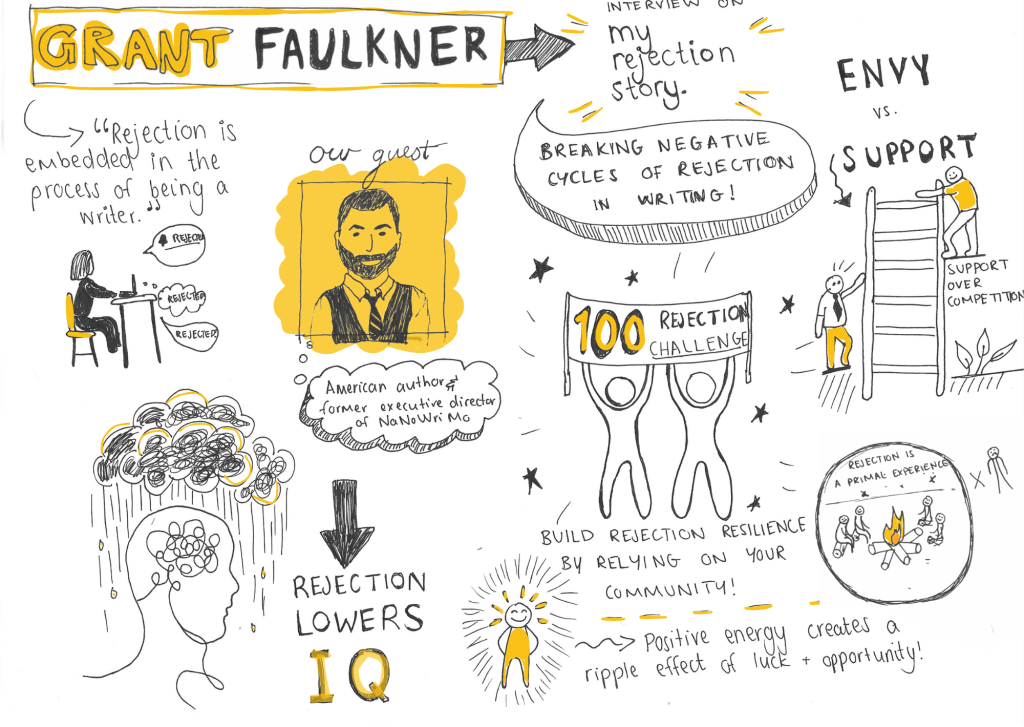
Grant Faulkner is a creative leader, prolific author, and the former Executive Director of National Novel Writing Month (NaNoWriMo). He’s seen rejection from every angle—both as an author and as someone who supports a global community of creators. With books like Pep Talks for Writers: 52 Insights and Actions to Boost Your Creative Mojo and The Art of Brevity: Crafting the Very Short Story, Grant has helped thousands of writers navigate rejection, build resilience, and discover the power of their creative voice.
Grant has done extensive research on the topic of rejection for writers as part of his latest book, which is currently in the querying stage. From exploring the science of how rejection impacts the brain to celebrating rejection as a badge of honor, Grant shares groundbreaking strategies to turn failure into fuel.
Order Grant’s Books:
Pep Talks for Writers: 52 Insights and Actions to Boost Your Creative Mojo: https://www.amazon.ae/Pep-Talks-Writers-Insights-Creative/dp/1452161089/
The Art of Brevity: Crafting the Very Short Story: https://www.amazon.ae/Art-Brevity-Crafting-Short-Story/dp/082636473X/
Learn More About Grant:
Grant’s Website: https://grantfaulkner.com
Grant’s Substack: https://grantfaulkner.substack.com
Instagram: https://www.instagram.com/grantfaulkner
Without you, this show wouldn’t be here. If you want to help us reach even MORE people, than please subscribe and review. Thank you so much!
Note: This is a rough transcript.
Alice Draper (00:01.037)
Grant, welcome to my rejection story. My first question for you is, what is your earliest memory of rejection?
Grant (00:09.178)
Wow, gosh, this is really getting into things. I’m on the psychotherapist’s couch here. You know, I think personal rejection, I went through a bad phase or a phase when I was, I think I was like 11 or 12. And I think I’m a middle child, middle children.
I think are maybe disposed to be sensitive to rejection. Maybe we think we’re overlooked. I don’t know, that’s the MO, that’s the psychological profile of the middle child is that we’re, I don’t know, maybe needy, maybe just highly sensitive. Anyway, I remember thinking that my sister was getting like an inordinate amount of attention and love and like, whatever, gifts, everything, the whole thing that went with that.
and feeling very kind of self-pitying and woe is me. So I think that was the first like prolonged experience of rejection. And, you know, it also includes, I mean, one, the need or the want of love and acceptance. And then two, you know, comparing myself to another and falling in a type of trap, right? I mean, especially for a kid’s mind, you know, I didn’t have any kind of cognitive resources or metacognition to kind of like
understand what I was going through. So yeah, guess I’ll say that, especially in terms of a rejection that’s not just a one-time hit, but that lasts for a while.
Alice Draper (01:37.178)
Is there a specific memory you have where you just felt like really unloved or that your sister was just being, yeah, getting what you didn’t have?
Grant (01:51.653)
think it was a single moment, you know, I think like when you’re I had I had three children in my family, I think it’s just probably pretty natural for kids to compare themselves and what they’re getting from their parents. It’s probably a developmental thing even we’re probably we need to go through that on some level. And you know, for most people, it kind of lasts a lifetime, I think, to some degree, I think that’s why families are so dramatic and combustible. Even the best behaved and
Alice Draper (02:13.124)
Yeah.
Grant (02:20.803)
most well-loved families, know, there are the moments, the cracks in the ceiling. So yeah, it wasn’t a specific moment, it was more me either noticing a pattern or projecting a pattern, or both, you know? I mean, who knows? It could have been true. And you know, I mean, now that I’m a parent, you do have, just like you do with your friends or anybody, you have moments or eras where you might connect more with them for whatever reason. It’s not like you love the others less.
Alice Draper (02:33.719)
Hmm.
Grant (02:50.948)
but you just connect with somebody more for a period. So I don’t know how to eliminate that from our human relations.
Alice Draper (02:58.424)
This is very interesting. So I’m tempted to go down the side path, but I’m going to move the conversation to your expertise. So you’re a bit of an expert in rejection based on my own research. Can you introduce yourself and the work you’re doing in the realm of rejection and rejection research?
Grant (03:04.826)
Anything you want.
Grant (03:21.562)
Yeah, you know, mean, to be expert in rejection, it’s really the definition of being a writer. And I’ve been a writer as my plan A since I was 20. And every once in a while when I’m talking to writers and hearing about the rejection and hearing about the burden of them, I’m like, wow, we chose to do this thing that exposes us to a crazy amount of rejection. It’s just embedded in the process of being a writer, you know? And I’m like,
I mean, we’re looking for punishment, you know, or we’re accepting that this will have a lot of punishment. We could have chosen other fields or just work normal day jobs and not had this degree of rejection. So it’s very fascinating. based on that, you know, like I say, to be a writer is to be rejected, and that’s true. But there are very few resources out there to help you deal with rejection, you know.
There’s the old cliches like grow a thick skin, know, toughen up, whatever, accept it, persistence, determination, all that stuff. But there really aren’t many books about it. There might be books about it, romantic rejection, but rarely the type of rejection that writers go through. so I, especially because I’m in contact with so many writers through my jobs and the publications I manage and stuff like that, I decided to write a rejection book.
book about rejection. And my premise for the book was like, one, let’s, you know, dig into some psychological research to understand why we react this way. And then and then two, the book profiled a number of writers with rejection stories, different types of rejection stories. So so the writers lives could be kind of like like they could operate as mentors for rejection. And then there’s like another part where I get get into resilience exercises.
and helping people think about, because I think if we have a strategy for rejection and a response and an understanding, we’ll just do a lot better with it. Because I’ve also talked to so many writers who really have given up, or they’re just fearful to put their things in the world because they’re just so fearful of rejection. I think everybody has different reactions to rejection. And so I think like, yeah, it’s a very interesting thing to help people think about.
Grant (05:41.841)
why they react to respond the way they do and how they can do that better.
Alice Draper (05:45.786)
Something that you write about in that work is you talk about how humans are social animals and that we’re genetically wired to seek social acceptance. Something I’m curious about is because humans are more individualistic than probably we ever have been in history, many of us now can…
live without seeing another person, we can sit behind our computers and code or do whatever and pay our bills and get food from the delivery person. That erodes, I guess, that need to cooperate to survive in the way that like in the past, we needed to work with the tribe a lot more to survive. Does that change the way that rejection affects us or is it still the same?
Grant (06:39.25)
I think so, that’s a great point because some of that is in my book proposal. So just to be clear for your listeners, my book isn’t a book proposal stage. It hasn’t been fully manifested or written. There have been sample chapters written. But I do think we’re really in a very perilous place in terms of rejection because of our more solitary existence. It’s funny because more solitary but more connected.
And we also get data that tells us how much we’re being loved or rejected, you know, or it looks like data in terms of how many likes we get, you know. So if I go out on Facebook right now and do this big confession or publish a poem, whatever it is, and it doesn’t get any likes, you know, that might be a more horrible rejection than getting a rejection slip from a publisher. And because the…
the people I might rely on for love, they’re also online, you know? And that’s what rejection really is. It’s not love. It can feel like it’s the opposite of love, even if it’s not intended that way. You know, we’re just highly sensitive creatures when it comes to rejection because we’re creatures who want to belong, you know? Like fundamentally, we want love and belonging beyond anything and before anything, maybe even before food. I don’t know. Get your food and water and shelter, but then we want love and belonging.
And so we’re wired like that in order to exist with groups. If you think about the initial way way back, the first humans, the first tribes, their strength came in their togetherness. And so to be kicked out of the tribe, you’re basically dead, right? You didn’t have people to care for you or to help you hunt and all that kind of stuff. So yeah, so it’s very primal and it’s very deeply wired into us.
And that’s why I think like a book like the one I was proposing, like we really have a need for that because no one is really helping us explore that part of ourselves so much. Rejection is a lonely thing in itself. Like a lot of people don’t want to confess that they feel like a vulnerability hangover when they publish a poem on Facebook or that they have hurt.
Grant (08:59.923)
You know, that they feel, you know what mean? We’re always putting up a good face. know, our culture, most cultures, I think, generally kind of emphasize that to appear strong. And maybe that’s part of being the belonging and love of the group is the more strong you appear, the more love you’re going to get. And if you’re really hurt and wounded, I don’t know. I’m just like theorizing here, but I think it’s just deep within ourselves. And I guess I strayed from your question because your question was really about our online kind of solitude.
But it all plays. Everything overlaps, I think. And that’s also where the online thing, people post their achievements, sometimes really proudly and wonderfully and sometimes competitively. And so just being online can also, even if you don’t post a poem or something like that, you’re seeing other people’s success, which can feel like rejection.
Alice Draper (09:33.144)
Hmm.
Alice Draper (09:52.826)
I mean, I think if I’m hearing you correctly, you know, that primal part of our brain is still there, the part that, fears rejection intrinsically deeply.
Grant (10:03.304)
Absolutely. Our brains have not evolved much, I don’t think. If at all, at least when it comes to rejection, love and belonging. mean, the most sophisticated person in the world who whatever studied endless degrees of psychology, if they get rejected from a lover, wife or husband, whatever, they will react as extremely as a teen.
Alice Draper (10:06.999)
Yeah.
Alice Draper (10:31.801)
Is this why we describe rejection in physical ways? Like, she broke my heart or it felt like a slap across the face.
Grant (10:32.585)
You know, we’re hard.
Grant (10:42.236)
Absolutely. And I think they’ve done, you know what, haven’t read my sample chapters in a while, but they’ve done studies where, the pain of rejection can be greater than physical pain actually. And if you think of, especially of heartbreak, you know, I think the rejection from love is even more intense, obviously, than the rejection of not getting a promotion at work or the rejection of not getting published.
And it has an intensity, you know, that drives some people to suicide, right? Or to really dark thoughts and self-destructive behavior. I mean, that’s the thing is that rejection can lead to really self-destructive behavior, whether that’s drugs and alcohol or just not sending your work into the world, not believing in your voice, you know, lot of self-doubt. So it just has so many different manifestations. And that’s why I think we have to get out ahead of it and really be able to think about it constructively and to break the
The taboos that I mentioned, it’s a taboo to… I mean, that’s why people don’t talk about their rejections. They don’t want other people to know them. They think they’re revealing weakness.
Alice Draper (11:48.292)
Yeah, yeah. I want to get into breaking the taboo a little bit later, but as you’re saying, you know, the rejection of heartbreak can drive people to suicide. I’m thinking of like actual examples. Like I recently watched Amy Winehouse’s movie. I don’t know how factually accurate it was, but her story was that the rejection of the man she loved is
Grant (12:03.488)
Hmm.
Alice Draper (12:11.096)
what drove most of our self-destructive behavior. Maybe people would say that there were other things involved as well. I’m sure there were, but it’s fascinating. It’s fascinating what rejection can do on the negative side of things.
Grant (12:14.081)
Is that right?
Grant (12:26.209)
I mean, I’m glad you mentioned that because I mean, fame, fortune, they don’t protect us from rejection. It’s a feeling. And that’s what’s so interesting. think sometimes when we see a celebrity either die from an overdose or suicide, where it’s like, but they were famous. They had all this money. They had everything. But they didn’t have everything because they were deeply wounded and they didn’t know how to handle that wound. And beyond that, though, I mean, the way we live now so much in public, I mean, we were talking about
living in public on social media. mean, everybody’s kind of a type of celebrity, right? We’re exposing ourselves to the world. And when I think I think of celebrities so differently these days, because every time they walk out of the house, they’re opening themselves up to like public scrutiny and public ridicule. And every time they put out a movie or book or whatever. And that’s an amazing thing to ask of a person to just to just openly put yourself out there for like
Criticism that’s going to happen no matter what whether it’s whether it’s just people online trolls or whether it’s more formal like a book review So yeah, I really think of celebrities as much different, you know that they need I think they need a lot of protective mechanisms to go out and do their job
Alice Draper (13:40.354)
Yeah, yeah, I totally agree. something that I ask many of the guests on this podcast is whether they became more averse or afraid of rejection as they advanced in their career. And the answer is almost always yes, like, because there’s now more to lose and people have this idea of you and you have a reputation to uphold. Whereas when you’re early in your career, you’re no one, no one has any expectation of you. So you can.
Grant (13:52.871)
Mm-hmm. Yes.
Alice Draper (14:06.605)
do whatever, get rejected by whoever. No one’s going to think anything of those rejections in the same way that they might later on.
Grant (14:13.399)
That’s exactly true and that’s a great question too. And I totally agree. Like the more that I’ve progressed in my career, actually the thinner my skin gets. And I tell this story, I’m forgetting, think it was Nathan Englander. He had dinner with Philip Roth and it was towards the end of Philip Roth’s life. And of course, Philip Roth, gosh, he’d won nearly everything except the Nobel Prize for Literature and he was highly bitter about that. But anyway.
Nathan Englinder asked Philip Roth, does it get any better? Does your skin get thicker with each book? And Philip Roth said, no, it gets thinner and thinner and thinner. And that might be because Philip Roth needed to read my book and work on his own response to rejection because he didn’t have exactly a constructive one. But at the same time, I think there’s irony there that success actually makes one more sensitive to rejection.
Alice Draper (14:55.897)
You
Alice Draper (15:05.624)
Yeah, yeah, I think it’s, you know, not resting it on outward things. The outward measures of success can feel very lonely if you don’t have a community, strong community to share it with. That would be my theory. But something that you write about is that rejection actually lowers our IQ temporarily, which I think is really fascinating. So.
Grant (15:10.578)
Mm-hmm. Mm-hmm.
Grant (15:18.038)
Yeah.
Grant (15:26.53)
Mmm.
Alice Draper (15:30.649)
Can you talk to me a little bit about what happens to our brain and our intelligence when we’re rejected? And that probably speaks to, know, the self-destructive behavior of cases like Amy Winehouse and many, many other people.
Grant (15:41.698)
I think so, yeah. I think just any extreme emotion, you know, fills the brain, takes away your ability to focus. I think we, when we’re rejected, we’re trying to figure out why. Like our brain starts churning through like why we aren’t good enough, you know, and it creates a type of anxiety and a type of like, again, like loneliness or solitude or feeling ostracized, you know, or just feeling like you’re not good enough. Like all of these negative emotions take over, right?
lack of self-confidence, self-doubt. And we also, the other thing interesting about our brains is our brains have a negative bias also hardwired. And this is evolutionary where we tend to tell negative stories about the world or our fears take over and project stories that it’s just a stronger force in our brains. And they’ve done all these studies, there’s a whole spectrum of negative bias and some people have it more than others.
The reason I said it was an evolutionary trait is because it protects us, right? We need a negative bias in order to modulate or moderate the risks we take. And so people who are well adjusted with a negative bias will take the proper amount of risks or less risks, and so they survive. Whereas people who have less of it might take more risks and not survive. So sorry, that was like a little bit of a tangent there. But I think like the premise though is that we do sort of lose control.
of our brains, our brains become, have less equilibrium. They’re less stable, they’re less balanced. And all these negative forces come in and we’re churning through things and churning through anxiety and stress and just trying to get back to that equilibrium and trying to understand how we can belong, you know, because that’s what we want in the end is to feel belonging, if not celebration, you know, go for it all. Yeah. And so I think that just naturally takes the brains, you know, any, any energy the brain had.
Alice Draper (17:32.281)
Mm-mm.
Grant (17:37.189)
for creativity or imagination. I think it’s similar to grief or mourning, any of these intense emotions that really overtake us. They don’t leave much room for anything else. And I used to say, for instance, that I didn’t believe in writer’s block, and I technically don’t. I can give you a writing prompt and a five-minute challenge to write as much as you can, and you’ll write for five minutes, I guarantee you, Alice.
Alice Draper (17:37.656)
Yeah.
Grant (18:02.34)
because I’ve done this thousands of times with people, literally. I have scientific proof that writer’s block doesn’t exist, except that writer’s block does exist if you’ve experienced something traumatic or if you’re depressed or if you’re feeling some of these feelings about rejection. And yeah, so I think it really is a creativity killer.
Alice Draper (18:03.321)
You
Alice Draper (18:20.698)
So maybe, yeah, working on rejection as a way to overcome writer’s block in some sense. So you talk about, you know, how the rejection emotional brain kind of takes over can put us in this cycle. And I’m curious to know how we can get out of the cycle, get out of the emotional brain, ruling our response, lowering our IQ and…
Something that you wrote about were the three stages of adversity coined by the psychologist Martin Seligman, that’s personalization, pervasiveness, and permanence. So could you talk to me a little bit about these and more specifically how we can break out of them, break free of them?
Grant (19:03.876)
Yeah, I mean, think there are a number of ways to do that. I mean, I think like per the negative bias comment that I had, we have a catastrophization that kind of speaks to like the personalization part, like, this is only happening to me. I’m the only author in the world getting rejected like this, or the only lover in the world getting rejected like this. And of course, we know that’s not true. And so it’s not pervasive and it’s not personal.
And so I think it’s really about one, having a metacognitive awareness of when you’re reacting like this and trying to adjust for it very consciously. But two, I think there are lot of different ways to have a strategy to fight those feelings like ahead of time, not to wait to be rejected, but to have a whole kind of systematized framework in place. And that’s what I’m finding.
really gratifying about our current world and the internet actually contributes to this. people, like I know people who like five of them will come together as a group. And this is good time to say that the beginning of the year of 2025 and they’ll each, they’ll set rejection goals. So let’s say those five people, some people choose 50, some people choose a hundred submissions that they want to put out there and get rejected by. the goal is to be rejected. And so they’ll do a spreadsheet. They’ll record their rejections.
They’ll celebrate both acceptances, but they’ll also celebrate when they hit rejection milestones, you know. So the goal is to get rejected and that means you’re putting your story out there more. And also that means opening more doors for possibility for acceptance, you know. So having something like that in place, it actually makes rejection kind of strangely fun, right? Because you’re doing it with others, you’ve broken the taboo, you’re having a conversation, you’re recording it and you’re celebrating.
and I’ve seen people, they’ll post on, social media, like I’m going for hashtag 100 rejections this year, you know, things like that. so making it public, breaking down the taboo, allowing yourself to, to talk about it instead of hide, you know, don’t be solitary. I mean, this is great too, because like rejection, makes us feel like we don’t belong and this kind of systemization of it makes it feel like, rejection is actually a pathway to belonging.
Grant (21:20.808)
And that’s what my book was about too, or will be about. It is just that rejection, we all experience it, you know? And it is like gratifying and cathartic to talk about it, you know, and to make it public. And even though like so many people put up this whatever, this certain front on social media, there are a lot of people who are also making themselves vulnerable and introducing topics like this.
Alice Draper (21:49.978)
of us so much. just basically shared my rejection origin story, which was being a part of a Facebook group full of journalists setting a rejection goal of 100 rejections and celebrating. And so for me, back then I was just a very amateur.
Grant (21:58.749)
Yeah.
Grant (22:05.895)
How cool.
Alice Draper (22:12.346)
writer getting my foot feet in the door. And so I was seeing these veteran journalists who had written for the New York Times and like all the big publications celebrating their rejections. And that did like a full 180 on my brain where I was like, they’re getting rejected. I can get rejected. And that was when I became more focused on output rather than, you know, ruminating over why I didn’t get accepted each time I didn’t get accepted.
Grant (22:26.129)
Yeah.
Grant (22:29.735)
Yeah.
Grant (22:37.318)
Yeah. Yeah.
Alice Draper (22:39.702)
So it’s such a great, and I talk about it in other spheres of life where I’m like, take that model and apply it to everything else. Like apply that to, you know, landing clients. If you’re in another kind of business, take it and apply it to sales, your marketing, to whatever it is that you’re doing. And it’s, I think it’s spoken about in the writing community, but I don’t see it spoken about in other communities.
Grant (23:03.785)
I think part of, yeah, you’re right. I haven’t done an official comparison of communities, but again, to be a writer is to be rejected. I think more so than probably other artistic fields. so, you know, we, to be a writer, you’re, you’re attracting a lot of people who are sensitive to begin with and full of self doubt, you know, and then, and then you’re dropping these bombs, you know, every day. And that I love your story about being in the Facebook group with these accomplished journalists because like,
Alice Draper (23:23.638)
you
Grant (23:32.34)
Part of my book proposal was I interviewed Marlon James and Marlon James, great writer, he’s won the Booker Prize, he’s won a bunch of prizes and his novels have been critically claimed. He told me, like in the course of interview, he says, don’t think I don’t get rejected now. And it kind of goes to what you were saying about Amy Winehouse, but also he was talking professionally, just because you’ve made it.
As you know, to someone like me from the outside looking in, doesn’t mean that everyone’s gonna be green lighting everything you wanna do. You know, you still have to prove yourself. You still have to prove the business, whatever it is, the possibilities, the artistic merit, something. And so rejection just is gonna be with us no matter how big and successful we get. It might be less of it, but as you said earlier, some of that can hurt more. So yeah, interesting lesson.
Alice Draper (24:27.534)
Yeah. Yeah. And so I love, you know, your takeaway of break the taboo, make it public. and something that’s interesting that actually is, think, big reason why I’ve ended up speaking so much about rejection is that people want to hear rejection stories. Like I, it’s a very anecdotal data point, but I noticed that if I ever spoke about rejection or failure that got a lot more engagement than anything else I ever talked about.
Grant (24:42.685)
Mm-hmm.
Grant (24:54.387)
Mm-hmm.
Alice Draper (24:56.695)
And I just did a podcast interview. was talking on another person’s podcast and she was saying that when she sends emails, if she ever shares something that went wrong, she gets like 10 X the number of responses versus when she shares something that went right in her life. And I think we’re starved for it because our natural inclination is to share success stories. And I understand that. It’s harder to share rejection stories, but I think people…
Grant (25:11.123)
Yeah.
Grant (25:17.18)
Right.
Grant (25:24.669)
It is.
Alice Draper (25:26.006)
once you hear those rejection stories. My next question for you is, does our genetic makeup impact how we perceive and react to rejections?
Grant (25:39.45)
yeah, definitely. I mean, like I said, we’re wired to be part of groups and every rejection, I mean, even if it’s a rejection from a literary journal, know, mean, technically we’re not being kicked out of the group with that, except it can feel that way, right? It can, can feel like your wider group of writers that you’re not good enough to be with them, that other people know how to do it better, that you’re somehow deficient.
and that you’ll be ostracized or left behind. you know, I mean, I think there are plenty of stories out there about friendships breaking up over one person, you know, being accepted somewhere and the other person being rejected, you know, or, you know, envy is really, I mean, what is it? do they call it? Envy is the, it’s the poison you drink. You drink your own poison, even though you’re focused on somebody else. And I think that that’s what can, kind of the harm that rejection can do, you know, it can,
lead to a lot of different types of self harm, whether it’s envy or doing drugs and alcohol or other kinds of self-destructive behavior. Yeah. So I think that’s the thing is that we’re wired for this and it’s not just us individually, although we have very different reactions to it, but it is a group phenomenon. Like you said, how wonderful to talk about it and to normalize it. And the more we normalize it, the less we’ll have people feeling like they’re kicked out of the group.
people, mean, ideally, I think we want people to say, this is just part of process. And in fact, you know, it is, I mean, it is a valuable part of process. Like a lot of my writing, I thank God that it wasn’t accepted. I thank God that like some books weren’t published. And every time I get rejected, it’s really a moment for me to do some introspection.
but also to look at the work itself and really judge it for myself. What are its merits? And is the critique, if a critique is offered, is it valid? Do I believe in that? I don’t have to believe in that. I can stick up, stand up and say my work’s good enough as it is, or it’s, you know, it is what it is. So yeah, so rejection can force questions, but some of those questions are constructive questions.
Alice Draper (27:45.913)
I love that you bring that up because I think that it can be easy. It can be easy to look at things black and white, like either the rejection means that I’m terrible and I should never write again. this is…
not if it’s a writing rejection or anything else, know, a romantic rejection to think that you’re unlovable and no one will ever love you or to think that that person like villainized that entire person, like that person was just a terrible, terrible person. so trying to take like merit, like figure out what that rejection, where that rejection was coming from is I think where the growth can happen.
Grant (28:08.309)
Mm-hmm.
Alice Draper (28:25.804)
So in a professional sense, like I think getting rejected, doing that 100 rejection challenge for me, made me realize what was going wrong in my pitches and how I could be better at pitching. And I think that’s where the growth happens professionally, romantically. If you’re rejected, maybe you played a part in, obviously maybe not in a dating context, but in a relationship context. Maybe there were things that where you could grow and become a better partner in the future for someone else.
Grant (28:36.511)
Mm-hmm.
Grant (28:40.299)
Mm-hmm.
Grant (28:54.368)
Mm-hmm.
Alice Draper (28:54.915)
from that. So, yeah, I’m curious to know if you have any insights on how someone could turn a rejection into a growth moment rather than either all good or all bad.
Grant (29:04.235)
Yeah, I mean, I think in some ideal world, you sometimes rejections are just they don’t tell you anything about why your work is being rejected. You know, I’m sticking to kind of like the idea of like submitting books or novels or stories. But, you know, often they do. And even even if they don’t, like, let’s say I submit a story to 20 literary magazines and all 20 rejected.
Alice Draper (29:13.177)
Mm.
Alice Draper (29:18.669)
Yeah.
Grant (29:29.021)
Well, that’s a type of consensus and it might be a great story because sometimes you have to submit the 30, 40, 50, 60 places literally to get that story published. But at the same time, you know, it’s a crossroads. know, if 20 magazines have rejected it, it’s worth, yeah, doing everything that you said, taking a step back, reading the story with a new editorial eye. Maybe, you know, rejection can help you get more objectivity. It can put you more in the editor’s role.
You can read it more through their eyes about, do they want to publish it in this in their journal and how would it fit in? You can make and then you can make kind of higher demands for yourself. I think it was a boy, Martha Graham, the choreographer and dancer. Excuse me. She she said that she, know, the creator was never at rest. The creator was always questioning and it was a state of divine dissatisfaction. And I love that because.
you’re questing for the divine, a type of perfection, but you’re guaranteed to be dissatisfied. And that’s because of your own demanding self. But it’s also because of rejection. mean, I rejection gets me to that level of divine dissatisfaction. It elevates my game if I look at it constructively, you know? And so I think that that’s what it’s about is both playing that game of numbers and statistics.
but also knowing that just sending a story to 100 places, that’s not doing anything. So that’s why I send my stories out, might be just to five literary journals or 10. And I allow for some pauses, some reckoning in there, where I am trying to learn some lessons. But then that’s just submission. mean, there’s the rejection you can feel when you…
give your story to your writing group, you know, or to a writing professor, you know, there’s other types of rejection in writing. And hopefully those though, I mean, I’ve received stories from professors who shouldn’t have done this, but they have given completely unhelpful and negative feedback, you know? I mean, that’s a type of thing to learn from. But generally, I think we look to those people for constructive feedback and to our writing group for constructive feedback, or we want to feel that it’s constructive and that’s said with love.
Grant (31:42.88)
So yeah, I think like, you know, we live in this kind of ecosystem of rejection, different types of rejection. And so I think it’s important to think about how to make that positive, you know, whether it’s your own reaction to rejection or creating a more supportive network, a community, you know, and that your community is part of the, I mean, the valuable thing about a community or writing group is that you’re getting feedback on your stories, but hopefully also getting motivation and inspiration and people cheering you on and feeling that togetherness, you know.
Because that’s one way to not feel alone when you’re rejected is to be with others.
Alice Draper (32:16.386)
Yeah, yeah, I firmly believe that the antidote is community. But you touched on something which is elevating your game. And I’m really curious about this, because I think that it can really go like one of two ways it can elevate or downgrade our game getting rejected. And I know I’ve been on the receiving end of what I perceived as very unconstructive rejection. And it’s very disheartening. think as writers, we put so much emotional
Grant (32:21.176)
Mm-hmm.
Grant (32:32.312)
Mm-hmm.
Grant (32:38.124)
Right.
Alice Draper (32:45.945)
tie so much of ourselves into our writing, more so than probably a lot of other things that we might get rejected for. So, so what does it take to, I guess, elevate your game? And I think also tying to like Envy, and you spoke about Envy earlier, but…
Grant (32:54.051)
Yeah.
Alice Draper (33:07.138)
You know, I’ve had moments of intense jealousy where someone’s gotten accepted and writes a writing opportunity or publication that I also applied for. And I think that for me, often that’s kind of spurred me on and made me try harder. But I know that that’s not the that’s not the effect it always has. yeah, what is a way to kind of be constructive with the rejections we have and use them in a way that’s
Grant (33:10.626)
Mm-hmm. Yeah.
Grant (33:16.419)
Yeah.
Grant (33:24.202)
Mm-hmm. It can be good.
Alice Draper (33:36.811)
elevates us rather than holds us back.
Grant (33:39.811)
Yeah, I think one way is just it’s a sign to yourself of how much you care, you know? And sometimes I think we need to recognize those moments of envy, not for being negative. But like you say, they can be motivating. They can tell us what we care about. And also, you know, the best advice I got, it was random. It was just a friend who had this response. And I think it was even before social media is that she was like, you know, because, you know, especially earlier on in my life when people were getting
Alice Draper (33:45.753)
Mm.
Grant (34:08.131)
successful before others, you know, it like the world was dividing into two camps, those who had doors open for them and those who didn’t. And her response was like, isn’t it great? We know these people and they’re our friends and they’re successful, you know, and that was like so constructive because one, she was saying, were there peers, you know, so the same thing could happen to us. And then the second thing she’s saying is that that that is the way success usually happens is that some people get the door open first, but then
Hopefully they’re there to open the door for you. know, so if you dig into envy too, too much, you’ll, you won’t allow them to help you, you know? And, and so that’s where envy can be a really destructive thing and a really isolating thing. And so that’s why I think it’s just really good to try to train yourself to celebrate others and celebrate their successes and to genuinely be happy for them. You know, there, I think there is, you know, this is my woo-woo side, but when you put positive energy out into the world, you know, it’s felt, you know, doors open.
Alice Draper (34:45.945)
Mm.
Grant (35:06.705)
And if you put negative energy out in the world, it’s also felt. So yeah, that’s my antidote to envy. And I think social media even maybe has a role. Because I think when it first came around, a lot of people just got caught up in the darkness of envy and comparison. And I think it’s been around for so long. And I know writers used to really feel nervous about self-promotion and anxiety and feel trepidation about posting successes even.
But I think we’ve see it’s become so normalized and we see it so much that I think it is a training ground to be like let’s just celebrate this person’s success. Let’s just help them, you know, so I think at its best, you know, it’s kind of maybe trained us to recognize how I don’t want to get on social media and feel envious. That’s just a bad way to be, you know, it’s no fun.
Alice Draper (35:57.249)
Yeah, yeah. love, you know, you’re saying it’s a sign that we care. And I completely agree. Like, I don’t think it’s woo woo to say that the positive energy, I’m sure there’s science to back that up. Like, if we’re
you know, responding to someone with intense negativity when they win something or achieve something or get something, they’re not going to be very likely to open that door for you because they just don’t want to be around us because we’re so negative. Whereas when it’s a very positive response, it’s just a positive association. And they’re going to be like, Hey, Grant, like never guess what? I don’t know. My editor asked for something that’s right up your alley. Can I intro you?
Grant (36:23.344)
Mm-hmm.
Grant (36:37.937)
Yeah, we’re attracted to positivity. You walk into a party, you generally don’t search out the darkest, gloomiest person in the room.
Alice Draper (36:41.516)
Yeah, yeah.
Alice Draper (36:47.737)
So I want to chat a bit about ADHD. So something that you wrote about is ADHD, rejection-sensitive dysphoria, which is something that’s linked to ADHD. So I have ADHD. I don’t know if I have RSD. How would someone know if they’re struggling with neurodivergent sensitivity to rejection?
Grant (36:54.129)
Mmm.
Grant (37:01.125)
Mm-hmm.
Grant (37:05.413)
Mm-hmm.
Grant (37:13.841)
That’s a question. This is a part of the book that since it’s in book proposal mode, I would have done more research on this if it had been accepted and if I was like pursuing it right now. So the only thing I know is that, know, ADHD, there’s not a scientific definition of that or a way to diagnosis. So it is more conceptual. You know, I know they can give you tests and they can measure your proclivities, your tendencies and things like that. But I think a lot of people…
you know, are identifying as ADHD, you know, our world as an ADHD world. I think that they are just kind of beginning to research some of these connections between like ADHD and having a thinner skin. So yeah, so I think I don’t know why that is necessarily. Although, you know, I mean, I think in general, we can think of the people who are drawn to the arts. And I just did read a statistic about this that
Alice Draper (37:43.897)
Mm.
Grant (38:11.174)
What was the statistic? It said 15 to 20 percent of the population is kind of more sensitive. They have more emotions and bigger emotions. And and and then if you think that the arts have drawn people like that just by nature, you know, that’s where we go. Then I think you can think of the arts as being like this whole big community of very highly sensitive and maybe not too sensitive. That’s the thing. I think that we.
We have these measurements that somebody’s too much or too sensitive or feels too much. And I think that’s really wrong because we want our artists to guide us to emotions and to open them up and to kind of feel them for us. That’s our job. But yeah, so there’s definitely a correlation there. And again, I think that’s why there’s so many stories like Amy Winehouse is out there. Like she was a highly sensitive individual. And to be an artist, you practice it, right?
Like that’s the other thing, like I wake up every day and I’m thinking about the things that people say. I’m listening more closely, you know, I’m noticing the world more closely, observing it more closely. So I’m kind of like to be a writer is to make myself more sensitive by definition. And then I’m opening myself up to exposure and all those dangers at the same time, you know? So it’s kind of a perilous field.
Alice Draper (39:32.205)
Yeah. Do you have any thoughts on that kind of opening yourself up for the arts side of things? Something I’m always curious about is vulnerability and being vulnerable on the page. You highlighted a point where you said earlier, if someone writes a very vulnerable post and gets no likes, can feel even more rejected. But so much of the art that artists are to create requires you to be vulnerable to…
Grant (39:38.461)
Mm-hmm.
Grant (39:46.739)
Yeah.
Grant (39:54.183)
Yeah.
Grant (39:59.506)
Yeah.
Alice Draper (39:59.705)
create something that’s meaningful and moving. How does someone know what, I don’t know, sort of what lines of strike when it comes to vulnerability?
Grant (40:10.011)
It’s a, I think it’s an ongoing practice. I mean, I think I have, I often say that being vulnerable on the page is the single most important thing you do as a writer, you know, so all these lessons about how to write great dialogue, how to write a bestselling plot, all those kinds of things. Those are very secondary because what we read for is intimacy and connection. And I think writers who can provide that, you know, that’s what, that’s what attracts me to my favorite writers. It’s like, I feel like I know that.
And I feel like they’re revealing themselves in these really fascinating ways to me. But I think like for you, you asked like how to recognize the boundaries. And I really do think that there’s no definition of what is good or bad in terms of boundaries. It’s all of what is acceptable to us and what we feel. And I know in my writing, like the older I get, I’ve got fewer shits to give, you know? And I’m also just more comfortable in my skin. And so I’m…
able to be more vulnerable now than when I was 20. So I think it’s a practice, you know, and that practice, you push boundaries, you know, by nature, that’s the definition of being a writer or an artist is you’re going to push boundaries, boundaries of yourself, but also boundaries of the art. And you’re going to test your comfort levels. And I mentioned the phrase vulnerability hangover that comes from Brene Brown.
And sometimes we’re going to put something out in the world and we’re going to feel a vulnerability hangover. We’re to be like, crap, you know, like I exposed too much of myself. People are going to hate me, whatever it is, you know? And so, but again, I think it’s, it’s practice and practice is necessary. know, it’s just like the practice of getting rejected, practice making yourself vulnerable. And, and also just accept that as part of the deal, you know, like, like if you want to write a book, you’re going to have to be vulnerable on some level, you know,
Alice Draper (42:03.449)
Yeah. Yeah.
Grant (42:03.83)
So practice accepting it. And I do think though the practice, know, like I used to not read in public, you know, I didn’t trust myself to read. I didn’t like to read in public and I was fear of embarrassment and fear of doing a poor job. And it just took me doing it a lot. And now I’m pretty comfortable at it, you know? I don’t think of worst case scenarios.
Alice Draper (42:23.001)
Hmm.
Grant (42:26.664)
So yeah, think through practice you can both open yourself up to more, you know, kind of exquisite artistic vulnerability, but also just like not have all the anxiety that you might have with it.
Alice Draper (42:36.033)
Yeah. I think there’s something to be said about muscle memory, knowing that you’ve done these hard things and survived them makes it not necessarily less hard, but you’re more likely to do it because you know that the world won’t end kind of.
Grant (42:50.161)
Exactly. I tell myself every time I mess up, after this podcast, I might be like, why did I say that? I’m like, no one will remember, you know, like a week from now, a month from now, no one will remember there. know, even if it was something egregious and horrible a year from now, two years from now, I don’t know. Think back about how much we remember that somebody, you know, if they stumbled on a word or did something embarrassing, we usually forget it. Move on. Our brains are kind of designed that way.
Alice Draper (42:59.513)
Mm.
Alice Draper (43:14.947)
Yeah.
Alice Draper (43:18.297)
Yeah, yeah, yeah. I also love that you touched on the vulnerability hangover, which I know you also spoke about earlier. And it makes me think of like kind of in my own times that I’ve written, I’ve maybe written a personal essay and I’ve definitely experienced the vulnerability hangover afterwards of being like, oh, was I, was I truly comfortable sharing that? And I think I feel like I can look back and say that I was always comfortable because I think I’d always reached the kind of growth arc of
the story to be able to share it. But there’s also this beautiful feeling that I’ve always had post vulnerability hangover, which is the feeling of connection, the feeling that your words impacted people and they definitely wouldn’t have impacted those people if I had not been very vulnerable and exposed on the page. So I guess the question I want to ask you is that something that I see with writers is not knowing whether that
Grant (43:57.333)
Mm-hmm.
Alice Draper (44:15.437)
fear of being vulnerable is a sign that they should not be vulnerable. And I guess how to know, not knowing whether that fear of being vulnerable is a sign that they should not be vulnerable. And I guess the question I want to ask you is there are times where I actually got essays rejected and I’m really glad that they were because I think that that would have been
Grant (44:23.904)
Say that one more time. Say that one more time.
Grant (44:30.614)
Mm-hmm.
Grant (44:37.504)
Mm-hmm.
Alice Draper (44:42.849)
too vulnerable in the sense that I think I was still in the pain. It was a wound, not a scar. And so it’s knowing like, you know, can you expose this and be vulnerable in a way that will make you feel good and feel like you’re actually in service to your readers versus you’re just exposing your traumas that you haven’t really worked through or processed yet.
Grant (44:46.592)
Yeah. Yeah.
Grant (45:01.387)
Yeah.
Grant (45:06.422)
Yeah, I think as a creator, as a writer, you are building the skills to do judging. You put it perfectly, like judging what’s in service to the story and what’s maybe in service to yourself or the story doesn’t need however you want to put it. And so that’s the way I think about it. You don’t want to be vulnerable just for vulnerability sake. You don’t want to totally open up all the doors. There’s no need for that most of the time. So I think you have to be selective and also to do it artistically.
and do it in a meaningful way. You are there and you’re presenting something to the reader. So the reader might not wanna know every embarrassing incident of your life. I use the word embarrassing with quotes around it, embarrassment’s something that society’s telling us, not that we’re telling ourselves. So yeah, think all this is like practice and attuning yourself to what is acceptable to you, attuning yourself to how you’re serving the story with your vulnerability. And I think if you’re comfortable,
with your vulnerability serving the story, you’re going to have less of a hangover, you know, because you’re going to be like, I was vulnerable for a reason, you know, and people should actually respect that reason. And you know what they usually do actually, like our vulnerability hangovers are something that we create a lot of times. Most of the time our readers or the people who are out there, you know, appreciating our art, they appreciate us taking that risk. I mean, I can’t tell you like I’m being the most vulnerable in my right now with my creations and my sub-stack newsletter.
this free newsletter once a week and I it’s called intimations of writers discourse and I really go I’m thinking about writing and creativity but I’m also thinking about myself and increasingly exposing myself and so I will have sometimes I’ll send it out and whoa it’s out there in the world thousands of people received it many of them who I don’t even know and and I’m always I’ll always have a nervous moment but it’s amazing to me that the more vulnerable and the more out there I am the more
authentic responses I get from people who say thank you. I feel the same way. You know, I feel the same way, but I wasn’t able to verbalize it. And again, that’s our role as artists, you know. That’s what we’re supposed to be doing. So that’s the other thing. I think when you know that that’s what you’re supposed to be doing, you’re building self-confidence so that you can do that, you know, appropriately.
Alice Draper (47:21.753)
It makes me think of the kind of find your values, find your why, the things that have been spoken about in so many different formats. But if you know why you’re sharing the story, I think you said it, you know, it’s easier to be vulnerable. I think it’s easier to take risks, you know, in life and business when we know why we’re doing it. But if there is just doing it for the sake of doing it, you can feel that misalignments about why you’re sharing the side of yourself. So I love that so much.
Grant (47:26.071)
Yeah.
Grant (47:29.932)
Yeah.
Grant (47:39.416)
Yeah.
Grant (47:48.738)
Yeah.
Alice Draper (47:51.009)
I think kind of to wrap things up, I want to know if there is like one, you know, major rejection takeaway that if people could take, if you have like a closing rejection takeaway, that maybe people could put into practice right now, if someone is feeling like they are not someone that seeks rejections in the healthiest of ways and wants to.
Grant (48:05.015)
Mm-hmm.
Grant (48:16.226)
Mm-hmm.
Alice Draper (48:17.291)
Either reframe their mindset or take more rejection risks. What is something they could do right now?
Grant (48:22.295)
Yeah, I think the first step is exactly that, like do some self analysis and really think about how you respond to rejection. And once you, and literally write it down, you know, like if you’re grabbing a bottle of wine every time you get rejected, that’s something to think about. You know, that’s not exactly a healthy response. And I’ve been there, so I can say that. Sorry, I’ve got this little cough. I’ll drink some coffee.
Alice Draper (48:38.97)
you
Alice Draper (48:47.139)
See you soon.
Take your time.
Grant (48:51.722)
Yeah, so think, you know, understanding why you react the way you do and really thinking about that, about, you know, taking away those destructive ways and think about how you could have a more constructive response. And part of that is, is knowing that you’re not alone, that happens to everybody. And so I say step two is being involved somehow with a community. And sometimes that means very formally involved, like with a writer’s group. Sometimes it means being just loosely involved, like going to, I know people who just go to a lot of readings, you know.
And they’re friends with people on social media. And so you do get kind of vicarious inspiration that way and vicarious comfort or to very tangible comfort if you’re in a writing group. And so I think doing some of those exercises like we talked about, like setting rejection goals are good and doing them with others. know, I think the power of others, that power of community is a great comfort and a great motivator and a great normalizer. Yeah.
Alice Draper (49:22.009)
Hmm.
Alice Draper (49:50.873)
Yeah. Yeah. Power of community. I a hundred percent stand with that. So I think that’s a great closing action item for anyone is to seek that community. It can be formal or informal. It can just be a group of friends you put together on a WhatsApp group. Grant for anyone who wants to find out more about you, your work, connect with you, follow your sub stack. Where can they find you and what can they connect you with?
Grant (50:07.074)
That’s, yeah.
Alice Draper (50:20.098)
What can they connect with you for? What sort of, I know obviously they can read your sub stack. Is there anything else they can do to work with you or be in your community?
Grant (50:22.582)
Yeah.
Grant (50:29.115)
Yeah, I’m on the main social media platforms. I mean, I dropped off Twitter, I have to say, but I’m mainly active on Facebook and Instagram, so please follow me. The substack is I do write this weekly newsletter. I put a lot of work into it. It’s free. So I really do hope that people sign up for that. Let me think beyond that, though. I do an accountability writing group with this group called Left Margin Lit.
And basically we do, we talk about some of these writing issues, whether they’re like craft or process or rejection stories. And most of it though is like us writing together, but it does have community built in as well. So that’s through Left Margin Lit. And it’s just showing up on Zoom and writing together, kind of like the rejection collective activities. Power of community again.
Alice Draper (51:14.201)
I love that so much. Well, all the links will be in the show notes. Grant, thank you so much for joining me on my rejection story.
Grant (51:22.436)
Thanks, Alice. This was really strangely fun to talk about rejection.
Alice Draper (51:25.625)
It was.

